Zencastr vs. Audio Audit (comparison)
 Damian Moore, Last updated: 15 October 2026
Zencastr has been recording remote podcasts since 2016 — it was one of the first tools to capture every guest as a separate, uncompressed local track so a flaky connection couldn’t ruin the tape — and in August 2026 it made the boldest pricing move in podcasting: the “vibecasting” relaunch, which folded almost the entire product into a free tier. Recording in 4K, the AI post-production podcasters used to know as ZenAI (now a chat assistant called your “Producer”), unlimited transcription, and unlimited podcast hosting: free, with a custom-priced Enterprise tier above it. Record the conversation, the pitch goes, and let the AI do the rest.
Audio Audit is the other half of a sentence like that: and then check what the AI actually did. It reads the finished episode, measures whether it’s fit to publish, fixes the specific things that aren’t, and keeps checking your feed after you’ve moved on. As of August 2026 the fixing is built in: with Enhancements, it applies noise reduction, speech levelling, loudness normalisation and clean metadata, and then you re-run the report to prove the numbers actually moved. Analyse, fix, verify.
The short version: Zencastr records and produces your show, now mostly for free; Audio Audit is the measuring instrument neither the free tier nor the Enterprise one contains.
This page was last fact-checked against zencastr.com in September 2026.
Comparison Overview
File and Metadata Checks
| Feature | Zencastr | Audio Audit |
|---|---|---|
| Metadata checking | ❌ No, episode details are typed in at publish rather than checked | ✅ Yes |
| Cover art checking | ❌ No — a minimum upload size is enforced, not an audit | ✅ Yes |
| Chapter checking | ❌ No, though the Producer can generate chapters for you | ✅ Yes |
| Bit-rate checking | ❌ No | ✅ Yes |
| Sample-rate checking | ❌ No, it records at 48 kHz rather than checking files | ✅ Yes |
| Sample-width checking | ❌ No | ✅ Yes |
| Channel count checking (stereo/mono) | ❌ No | ✅ Yes |
Analysis and Detection
| Feature | Zencastr | Audio Audit |
|---|---|---|
| LUFS/loudness checking | ❌ No, it normalises to a target without reporting a measured figure | ✅ Yes |
| Peak volume checking | ❌ No | ✅ Yes |
| Noise floor checking | ❌ No | ✅ Yes |
| Unwanted noise detection (coughs, knocks, pets, etc.) | ❌ No, noise is reduced rather than flagged | ✅ Yes, dozens of noise types |
| Filler word detection (uhm, ahh, etc.) | ✅ Yes — English only, removed as part of the AI pass | ❌ No |
| Long silence detection | ✅ Yes, long pauses are shortened to a length you choose | ✅ Yes |
| Restarted sentence detection | ❌ No | ✅ Yes |
| Swearing detection | ❌ No, the explicit flag is a checkbox you tick yourself | ✅ Yes |
| Automatic transcriptions | ✅ Yes, unlimited hours (a handful of languages) | ✅ Yes |
Enhancement and Editing
| Feature | Zencastr | Audio Audit |
|---|---|---|
| Audio file modification | ✅ Yes | ✅ Yes (Enhancements) |
| One-pass enhancement of a finished episode | ✅ For Zencastr-recorded audio — uploads don’t get levelling or noise reduction | ✅ Yes, on any file — measured processing, no generative AI |
| Noise reduction | ✅ Yes — noise reduction, noise gate and cross-gate, on native recordings | ✅ Yes, profile measured from your recording |
| Speech levelling (compression) | ✅ Yes, the Leveler balances speakers on native recordings | ✅ Yes |
| Loudness normalisation (LUFS targets) | ✅ Yes — default -19 LUFS, adjustable from -13 to -31 | ✅ Yes, presets for podcasts, YouTube and ACX |
| Metadata & cover art writing | ❌ No | ✅ Yes, without re-encoding audio |
| Automatic filler word removal | ✅ Yes, English only | ❌ No |
| Automatic silence removal | ✅ Yes | ❌ No |
| Transcript-based editing | ✅ Yes, plus a chat “Producer” that edits on instruction | ❌ No |
Monitoring and Reporting
| Feature | Zencastr | Audio Audit |
|---|---|---|
| Automatic reports by email | ❌ No | ✅ Yes |
| RSS feed monitoring | ❌ No — it serves your feed rather than checking it | ✅ Yes |
| Scoring over the long-term across shows and team members | ❌ No, analytics count listeners, not audio quality | ✅ Yes |
Plans and Pricing
| Feature | Zencastr | Audio Audit |
|---|---|---|
| Free trial | ✅ Not needed — the free tier is nearly the whole product | ✅ Yes |
| Free tier | ✅ Yes, remarkably generous since August 2026 | ✅ Yes, free credits every month |
| Pricing model | Free (“Vibecastr”) plus a custom-priced Enterprise tier | Pay-as-you-go credits or subscription — see /pricing |
| One-off credit top-ups (no subscription needed) | — | ✅ Yes — credit packs valid 12 months |
The Free Studio
Credit first, because the August 2026 relaunch made Zencastr one of the most generous propositions in podcasting. The core competence is a decade old and real: every participant records locally — 16-bit, 48 kHz WAV plus a safety MP3, per person — so the recording survives whatever the internet does to the call. On top of that now sits the production line: text-based and multitrack editing, an AI pass that levels speakers, gates and reduces background noise, strips English filler words and shortens long pauses, chapter and show-notes generation, 4K video with social-ready reframing — and a conversational “Producer” you can simply instruct. Then unlimited hosting: “no episode caps, no storage limits, no upcharging as your show grows”, with distribution to the directories. Practically all of it free.
One more thing worth respecting: Zencastr drew an explicit line on AI. Its relaunch post commits that “AI should help humans make podcasts and not the other way around” — no generated podcasts, no voice cloning. In 2026, that’s a stance, and a good one.
Audio Audit does none of the making, and we have no plans to bluff at it. No recorder, no editor, no host. We detect — long silences, restarted sentences, coughs and car alarms, each with a timestamp — and you fix them in your production tool. Zencastr, quite possibly. Filler words we don’t detect at all; Zencastr’s AI pass strips the English ones for you.
Loudness: A Number You Can Set — and the Fine Print Under It
The standard loudness for podcasts is -16 LUFS, and our customers tell us it’s the number one thing they check their reports for.
Zencastr does better here than most of its category, and the credit is specific: its audio enhancement documentation actually names a loudness target — -19 LUFS by default, adjustable anywhere from -13 to -31. A stated, adjustable number beats the silent black boxes we keep writing about, and we’re glad to say so. Now the fine print, in three parts. First, the default: -19 LUFS is the mono convention; if your show publishes in stereo, the standard is -16, and leaving the slider where it starts ships a noticeably quieter episode. Second, nothing reports back: no measured before-or-after figure ever appears, so “set to -19” and “landed at -19” remain a matter of trust. Third — and this is the catch most users find late — the good processing is for Zencastr’s own recordings: upload a pre-recorded file and, by Zencastr’s own documentation, the levelling and noise reduction aren’t available, because uploads lack the per-participant data those features need.
Audio Audit works on any file from anywhere, and measures at both ends. Volume normalisation ships with presets for podcast platforms (-16 LUFS), YouTube (-14 LUFS) and ACX audiobooks (-19 LUFS), all with true-peak-safe limiting and a custom option, built on the same ITU-R BS.1770 model broadcast uses — measure the whole episode, apply one constant gain change, never touch how it breathes. Then the fresh report puts the achieved integrated loudness next to the true peak, in writing, whichever tool made the episode.
What the Producer Doesn’t Check
Zencastr’s AI produces; it doesn’t inspect. Nothing reads the finished file the way a podcast directory will — no metadata or artwork audit, no bit-rate, sample-rate or channel report, no noise-floor measurement, no restarted sentences, and the explicit-content flag is a checkbox you remember to tick, with no swearing detection behind it. And although Zencastr serves your RSS feed, nothing checks what’s in it: its analytics count listeners and geography, not audio quality.
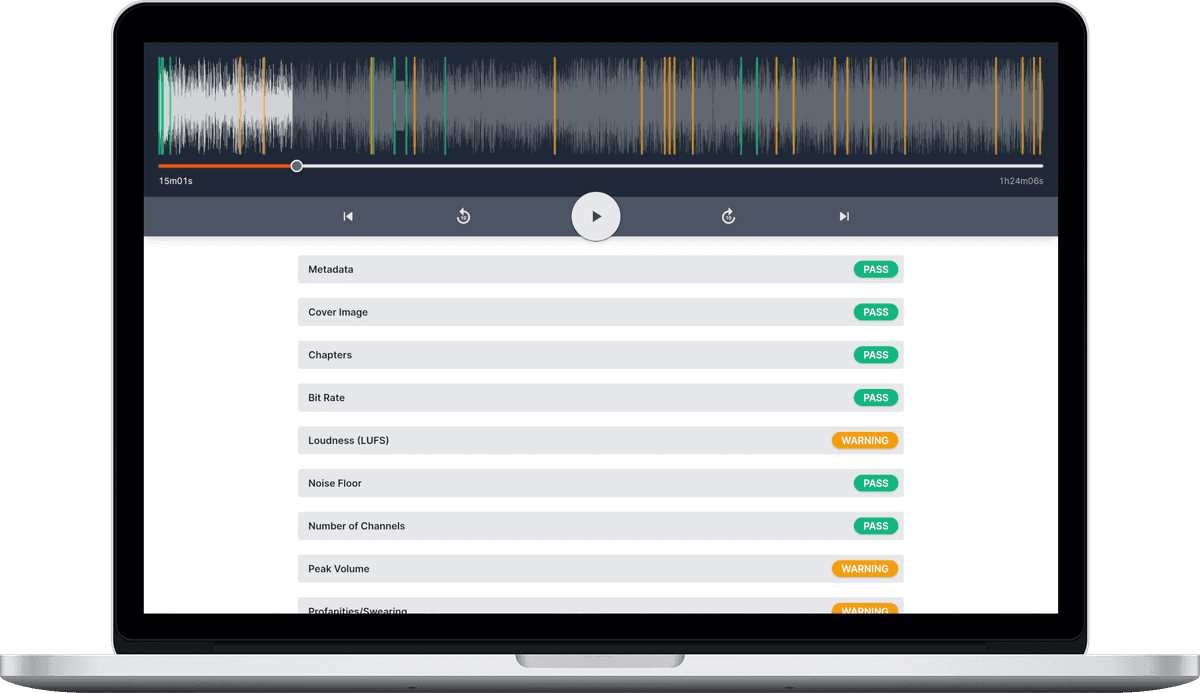
That’s the whole of Audio Audit’s territory. The report checks the finished episode against everything a directory and a listener care about, with the failing checks’ fixes pre-ticked — and if metadata is the only thing you change, the audio isn’t re-encoded at all. Then the feed monitor re-checks the file your host actually serves — a Zencastr-hosted feed included — because hosts re-encode, and a re-encode can shift your loudness and clip your peaks long after the Producer’s work is done. Reports arrive by email, scores build across episodes, shows and team members, and the trend tells you whether your audio is quietly getting worse.
Paying For It
Zencastr’s current pricing takes one sentence: nearly everything is free, and teams with special needs talk to sales about Enterprise. Be aware that most third-party review sites still show the pre-relaunch tiers ($24/$40/$80 a month) — that structure is gone from zencastr.com as of September 2026, and zencastr.com/pricing is the only source worth trusting on it. A free-everything model this fresh may well evolve; that’s one more reason to check the page rather than this paragraph.
Audio Audit runs on credits, with free credits every month, monthly plans if your usage is steady, and one-off top-up packs valid for 12 months if it isn’t. Reports and enhancements draw on the same balance — a full clean-up costs about the same per minute as a full standard analysis — and you see the estimate before you commit. Current prices live on the pricing page rather than in this article, because comparison pages go stale and pricing pages don’t.
So Which One?
If you want to record remote conversations properly and let an AI do the production — and pay nothing while you find out whether podcasting sticks — Zencastr’s relaunch has made it one of the easiest recommendations in this series. The local-track recording is the real thing, and the free tier is close to the whole product.
If you want to know what the finished episode actually is — the loudness figure the Producer sets but never reports, the checks no studio runs, the fixes verified by measurement, and a monitor on the feed your host serves — that’s Audio Audit.
And the chain is clean: record and produce in Zencastr, publish to its free hosting, and point Audio Audit’s feed monitor at the result — every episode checked as your listeners will actually receive it, from now on. For pre-recorded files Zencastr’s enhancements won’t touch, run them through Audio Audit first; measured noise reduction and levelling work the same whoever pressed record.
Want the full detail on what Audio Audit’s enhancements do? See the Enhancements announcement and the Enhancing Audio guide, or head to the Pricing page to see what a report or an enhancement costs for your episode length. Comparing other tools too? We’ve written the same honest breakdown for Riverside, Alitu, Auphonic, Descript, Adobe Podcast Enhance and Cleanvoice.
Photos courtesy of Panuson Norkaew