Alitu vs. Audio Audit (comparison)
 Damian Moore, Last updated: 1 September 2026
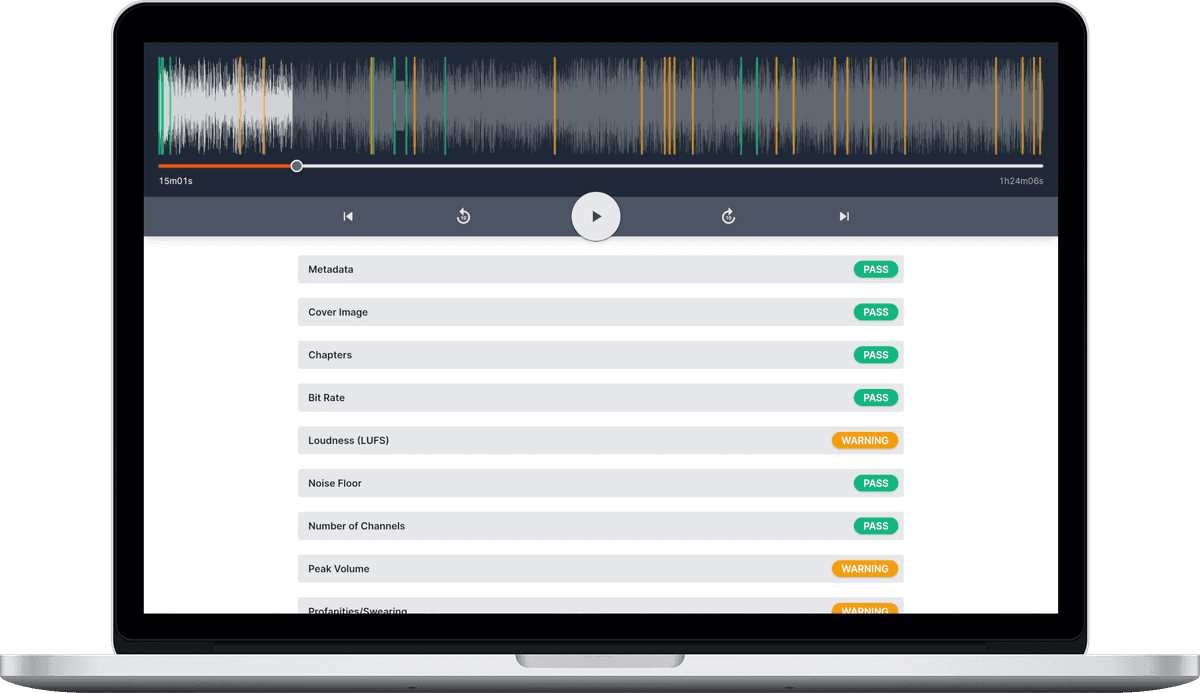
Alitu and Audio Audit aren’t really competitors, and this page will be more useful if we say so in the first paragraph. Alitu, built by the team behind The Podcast Host, wants to be the only podcasting tool you need: you record into it or upload to it, edit inside it, let it clean up your audio and add your music, and publish straight to its own hosting — transcript, website and analytics included. Audio Audit is a quality-control instrument pointed at the finished file: it measures what you made, tells you whether it’s fit to publish, fixes the specific things that aren’t, and keeps checking your feed after you’ve moved on to the next episode.
Where the two overlap is the clean-up. Alitu runs noise reduction, hum removal, volume levelling and EQ over everything you put into it, automatically, as part of its pitch that the technical decisions are made for you. Audio Audit, as of August 2026, fixes things too: with Enhancements, it applies noise reduction, speech levelling, loudness normalisation and clean metadata, and then you re-run the report to prove the numbers actually moved. Analyse, fix, verify.
The short version: Alitu makes your episode and makes the technical decisions for you; Audio Audit measures the episode you made and shows you the numbers.
This page was last fact-checked against alitu.com in September 2026.
Comparison Overview
File and Metadata Checks
| Feature | Alitu | Audio Audit |
|---|---|---|
| Metadata checking | ❌ No, though ID3 tags are written on export | ✅ Yes |
| Cover art checking | ❌ No | ✅ Yes |
| Chapter checking | ❌ No, though it can generate and add chapters for you | ✅ Yes |
| Bit-rate checking | ❌ No | ✅ Yes |
| Sample-rate checking | ❌ No | ✅ Yes |
| Sample-width checking | ❌ No | ✅ Yes |
| Channel count checking (stereo/mono) | ❌ No, episodes are converted to mono | ✅ Yes |
Analysis and Detection
| Feature | Alitu | Audio Audit |
|---|---|---|
| LUFS/loudness checking | ❌ No, it normalises to a fixed target without reporting the figure | ✅ Yes |
| Peak volume checking | ❌ No | ✅ Yes |
| Noise floor checking | ❌ No | ✅ Yes |
| Unwanted noise detection (coughs, knocks, pets, etc.) | ❌ No, steady background noise is removed rather than flagged | ✅ Yes, dozens of noise types |
| Filler word detection (uhm, ahh, etc.) | ✅ Yes, Magic Filters mark them in the editor | ✅ Yes |
| Long silence detection | ✅ Yes, flagged and cut by Magic Filters | ✅ Yes |
| Restarted sentence detection | ❌ No | ✅ Yes |
| Swearing detection | ❌ No, though the editor can bleep words you find | ✅ Yes |
| Automatic transcriptions | ✅ Yes, 104 languages, 12 hours a month included | ✅ Yes |
Enhancement and Editing
| Feature | Alitu | Audio Audit |
|---|---|---|
| Audio file modification | ✅ Yes | ✅ Yes (Enhancements) |
| One-pass enhancement of a finished episode | ✅ Yes, clean-up runs automatically on upload | ✅ Yes — measured processing, no generative AI |
| Noise reduction | ✅ Yes, including hum removal | ✅ Yes, profile measured from your recording |
| Speech levelling (compression) | ✅ Yes | ✅ Yes |
| Loudness normalisation (LUFS targets) | ✅ Yes, one fixed target: -19 LUFS in mono | ✅ Yes, presets for podcasts, YouTube and ACX |
| Metadata & cover art writing | ✅ Yes, ID3 tags on MP3 export | ✅ Yes, without re-encoding audio |
| Automatic filler word removal | ✅ Yes, via Magic Filters | ❌ No |
| Automatic silence removal | ✅ Yes, via Magic Filters | ❌ No |
| Transcript-based editing | ✅ Yes, alongside a waveform editor | ❌ No |
Monitoring and Reporting
| Feature | Alitu | Audio Audit |
|---|---|---|
| Automatic reports by email | ❌ No | ✅ Yes |
| RSS feed monitoring | ❌ No, though Alitu can host and publish your feed | ✅ Yes |
| Scoring over the long-term across shows and team members | ❌ No, download analytics only | ✅ Yes |
Plans and Pricing
| Feature | Alitu | Audio Audit |
|---|---|---|
| Free trial | ✅ Yes, 7 days with 2 hours of processing (card required) | ✅ Yes |
| Free tier | ❌ No, every plan is paid once the trial ends | ✅ Yes, free credits every month |
| Pricing model | Subscription only | Pay-as-you-go credits or subscription — see /pricing |
| One-off credit top-ups (no subscription needed) | ❌ No | ✅ Yes — credit packs valid 12 months |
Making an Episode: Alitu Wins the Whole Journey
If what you want is one tool that takes you from “I have something to say” into a published episode, Alitu is built for exactly that, and it does the job well. You can record solo in the app, open a shareable studio to record guests in video and audio, or upload whatever you already have from your phone, Zoom or computer. Editing happens in a transcript or on a waveform, whichever suits you — highlight the text you don’t want, click “Cut this out”, and it’s gone. Not permanently gone, either: nothing gets deleted in Alitu, and you can bring back any cut with a couple of clicks, even after the episode has gone live.
The stand-out editing feature is Magic Filters: toggle them on and Alitu finds the unwanted silences and the filler words — the ahs and the ums — and creates the edits for you, each one adjustable, previewable or removable before you commit. That’s the honest way to automate a destructive edit, and it’s better than tools that silently hand you back a shorter file and let you guess what went missing.
Around the editor sits the rest of the production line. A free music library with automatic fades and transitions. Transcription in 104 languages, with 90%+ accuracy claimed for 14 of them, and twelve hours of it included each month. AI-generated chapters (English only for now, their docs note) plus AI help with episode titles and descriptions. Then publishing: Alitu’s own hosting is free until you pass 1,000 downloads a month, distributes to Apple Podcasts, Spotify and the rest, and comes with a free podcast website and download analytics — or it will push episodes to Captivate, Buzzsprout, Libsyn and other hosts if you already have one. There’s even a human managed-editing service, from $295 a month, if you’d rather hand the whole job to a person.
Audio Audit does none of this, and we have no plans to bluff at it. There is no recorder, no editor, no music library and no hosting. We detect filler words and long silences and mark them with timestamps so you know how much of a problem you have and where it is, but you cut them somewhere else — in Alitu, quite possibly.
Clean-up: House Style vs Measured Processing
Alitu’s audio clean-up runs automatically on everything you upload or record, and its help centre is clear about what that means: noise reduction for regular background noise, hum reduction for power-related hums, levelling to even out volumes, and EQ and mastering “done for you, using AI” to make voices sound “deep, vibrant and easy on the ear”. You can adjust how the clean-up treats your next upload, but the default posture is that Alitu decides. For its audience — people who don’t want to know what a compressor is — that’s the whole appeal, and we won’t pretend otherwise. It’s also simply ahead of us on EQ: there is no EQ in Audio Audit at all.
Audio Audit’s processing is deliberately different in character. Noise reduction builds a profile from the quietest moments of your recording — your room’s particular hum, hiss and air conditioning rather than a generic guess — and subtracts it frequency by frequency, with a soft gate that lowers the level between phrases instead of hard-muting them. It’s capped at 12 dB, safely below the point where spectral processing on speech starts to sound underwater; if your recording is noisier than that, the honest fix is at the source, and we’d rather tell you than quietly make your audio worse. Speech levelling is a compressor whose threshold is set from your own measured speech level, not a fixed number. Nothing is generative, and nothing is a black box: every stage is a measurement followed by a deterministic change.
The deeper difference isn’t any single processor — it’s that Alitu never shows you a number. Audio flows in, better audio flows out, and you take the improvement on trust. Audio Audit measures first, fixes second, and then the fresh report tells you what the file actually is now. If trusting the machine has always worked for you, you don’t need us. The day an episode comes out sounding wrong, the measurements are what you’ll wish you had.
Loudness: The House Number vs a Target You Choose — and Verify
The standard loudness for podcasts is -16 LUFS, and our customers tell us it’s the number one thing they check their reports for.
Alitu handles loudness with one house rule. Its help centre states that episodes are converted to mono and normalised to -19 LUFS integrated loudness with a -1 dB true peak. Let’s be fair about that figure before we argue with it: for a mono file, -19 LUFS plays back at roughly the same perceived loudness as a stereo file at -16, so this is a recognised broadcast convention, correctly applied — not a mistake.
But notice what the rule costs you. The mono conversion isn’t a choice: if your show has a stereo music bed, stereo guests or any deliberate left–right space, it collapses. The target isn’t a choice either — there’s no -14 LUFS for YouTube, no ACX preset for audiobooks, no custom value. And the figure is never reported: not measured before, not confirmed after.
Audio Audit treats loudness as your decision, verified. Volume normalisation ships with presets for podcast platforms (-16 LUFS), YouTube (-14 LUFS) and ACX audiobooks (-19 LUFS), all with true-peak-safe limiting and a custom option if your target is something else. It’s a two-pass measurement built on the same ITU-R BS.1770 loudness model broadcast uses: measure the whole episode, then apply a single constant gain change, so normalisation changes how loud your episode is and never how it breathes. Your channel count is checked and reported, never changed — mono is a perfectly good choice for a spoken-word show, but it should be yours to make. And when the processing is done, you re-run the report and the loudness figure lands next to the true peak, in writing.
What an Audit Adds
Everything above is about making an episode better. An audit answers a different question: is the file you’re about to publish actually right?
Audio Audit’s report reads the finished file and checks it against everything a podcast directory and a listener cares about: bit rate, sample rate, sample width, channel count, peak level, noise floor, loudness, swearing, restarted sentences, filler words, long silences, missing metadata, and cover art that directories will reject. Where a check fails, the enhancement that would fix it comes pre-ticked on the report — and if metadata is the only thing you change, the audio isn’t re-encoded at all. Alitu writes ID3 tags when it exports your MP3, which is more than many tools bother with, but nothing in it will examine a file it didn’t make and tell you what’s wrong with it — and its analytics count downloads, not audio quality.
Then the audit keeps going after you publish. Point Audio Audit at your RSS feed — an Alitu-hosted feed included — and it re-checks the file your host actually served, which isn’t always the file you uploaded: hosts re-encode, and a re-encode can shift your loudness and clip your peaks long after every tool in your production chain has finished and gone home. Reports arrive by email, scores build up across episodes, shows and team members, and the trend tells you whether your audio is quietly getting worse. Alitu’s job ends when the episode goes out; ours is only half done at that point.
Paying For It
Alitu is a subscription, full stop. As of September 2026 it’s $38 a month, or $380 a year (two months free) — £32 and €38 a month in the UK and Europe — with every feature on every plan, unlimited episodes and storage, twelve transcription hours a month, and hosting free until 1,000 downloads a month with paid tiers ($10, $30, $60 a month) beyond that. There’s a 20% discount for non-profits, you can pause for up to three months, and there’s a 30-day money-back guarantee. The trial is 7 days with up to 2 hours of audio processing, and it wants your card up front. Check alitu.com/pricing for today’s figures rather than trusting this paragraph in a year’s time.
If Alitu replaces an editor, a host and a website builder for you, that price is honest value — you’re paying one bill instead of three. The catch is that it’s the only door in: there’s no free tier, no pay-as-you-go option, and no way to use it occasionally without a running subscription.
Audio Audit runs on credits, with free credits every month, monthly plans if your usage is steady, and one-off top-up packs valid for 12 months if it isn’t. Reports and enhancements draw on the same balance — a full clean-up costs about the same per minute as a full standard analysis — and you see the estimate before you commit. Current prices live on the pricing page rather than in this article, because comparison pages go stale and pricing pages don’t. If you publish monthly, or you just want one troublesome episode checked and fixed, nobody is asking you for a subscription.
So Which One?
If you’re starting out, or you want podcasting to feel like filling in a form rather than operating a studio — record, click, published, with the technical decisions made for you and one bill covering editing, hosting and a website — use Alitu. That’s the product, it’s honest about being that product, and Magic Filters plus text-based editing will save you real hours every episode.
If you want to know whether the finished file is actually up to standard, with the measurements to back it up, fix the specific things that aren’t, choose your own loudness target and keep your stereo, and then keep an eye on every episode you publish from here on, that’s Audio Audit.
And the two chain together without friction. Make your episode in Alitu, click “Download as mp3”, and run the file through Audio Audit before you publish — the report will tell you what the production line actually produced. Then point the feed monitor at your show, Alitu-hosted or otherwise, and let it check what your listeners are really being served, every episode, from now on.
Want the full detail on what Audio Audit’s enhancements do? See the Enhancements announcement and the Enhancing Audio guide, or head to the Pricing page to see what a report or an enhancement costs for your episode length. Comparing other tools too? We’ve written the same honest breakdown for Auphonic, Descript, Adobe Podcast Enhance and Cleanvoice.