FAQs (Frequently Asked Questions)
Getting started
What is Audio Audit?
Audio Audit is an online tool for finding — and fixing — problems in audio files. It analyses your audio and produces a report covering loudness, background noise, silences, encoding, metadata and more. You can then apply enhancements to clean up what it found. Think of it as automated quality assurance (QA) for your production pipeline.
Who are the intended users?
Audio Audit is designed to be used by self-produced podcasters, audio engineers and producers, and by podcast networks checking output across many shows. We focus specifically on the needs of podcasters but it can be useful in other sectors as well such as audiobooks, music and video.
Are there any prerequisites?
You do not need any special equipment to use Audio Audit. Most laptops, tablets and phones will work as long as they have a recent web browser.
To analyse something you’ll need either an audio file to upload — MP3, M4A, WAV or FLAC, up to 255MB each — or an existing published podcast feed, which you can paste the URL of or search for by name. Creating Reports covers both routes. You can also send files and feeds in programmatically using our REST API.
How do I get started?
You can get started very quickly by signing up on the registration page. You will then be automatically enrolled in the free plan, which gives you 600 credits a month — about an hour of audio — and needs no credit card. From your dashboard, the “Generate Report” box takes either a podcast name to search for or a feed URL to paste, and you can drop audio files straight onto it. Our quick start guide walks through the first report step by step.
When should Audio Audit be run?
If you have a podcast episode or similar that you’ve already published then it can be insightful to upload that first to see how it scores. This will help you make adaptations to your workflow before your next episode. Going forward you’ll probably want to test audio files just before you publish them to your podcast feed.
If you turn on automatic checking for a podcast we will regularly check its feed for new episodes, analyse them as they appear and email the report to whoever you’ve chosen.
Analysis and checks
What checks get run as part of the audit?
Every report runs the full set of checks — loudness and peak levels, noise floor, background and unwanted noises, silences at the start, end and in the middle, restarted sentences, profanities, bit rate and bit rate variability, sample rate, bit depth, channel count and quiet channels, cover image, metadata tags and chapter markers.
The checks section of our home page covers the ones we get asked about most, a section each, with the remainder gathered together under “…and we check these too”. Understanding Reports explains how to read the results, and our Podcast Articles section goes into more detail on each one.
Do I get a transcript?
Yes. Every report includes a transcript unless your own standard switches it off. It’s an automated transcription, broken into timestamped phrases — click a timestamp to jump the player to that moment. The language is detected automatically. You can download it as a WebVTT or SRT subtitle file, or as plain text. It is machine generated, so proof-read it before you publish it anywhere.
Does Audio Audit make changes to my audio files?
Never without you asking. The checks are read-only — the results are suggestions and it’s up to you to review and decide whether to act on them. If you choose to use our audio enhancements, we apply your selected fixes to a separate enhanced copy for you to download — the file you uploaded is never modified.
Enhancements and chapters
What are Enhancements?
Enhancements fix the problems a report finds. There are four clean-up passes — noise reduction from a measured noise profile, speech compression, volume normalisation to an industry loudness target, and clean metadata tags and cover art — plus automatic chapters. You pick the ones you want and they run as a single job.
You can start one from any finished report, where the checks that failed are pre-selected for you, or from the “Enhance Audio” card on your dashboard for a file that has no report. Enhancing Audio covers each pass and its settings.
What format do I get an enhanced file back in?
By default the same format you uploaded. You can also export as MP3 at 128, 192, 256 or 320 kbps, or as lossless FLAC. Loudness normalisation has presets for podcast (−16 LUFS), YouTube (−14 LUFS) and ACX audiobook (−19 LUFS), or you can set your own target. If you only change metadata and keep the original format, we rewrite the tags without re-encoding the audio at all.
Can Audio Audit create chapters for me?
Yes. Automatic chapters proposes chapter titles and timestamps from a transcript of your episode. Nothing is final until you say so — you get an editor to rename, retime, add and delete chapters first. If your file already has chapter markers we read those back in for you to edit rather than starting from scratch.
Finished chapters can be downloaded as a Podcasting 2.0 JSON chapters file or as a plain-text list, and the metadata enhancement writes them into the file itself for MP3, WAV, FLAC and MP4.
Credits and billing
What are credits and what gets spent on what?
Credits are the single currency for everything Audio Audit does, so you are never juggling separate allowances. As a rule of thumb, 600 credits is about an hour of standard analysis. Running the full set of clean-up enhancements over a file costs roughly what analysing it does, and lighter jobs cost proportionately less — a metadata-only pass is far cheaper than noise reduction.
Analysis, enhancement and chapter generation are charged as separate jobs, and each job has a minimum charge of ten audio minutes, so a two-minute trailer is billed as ten. Chapter generation is charged when the proposed chapters arrive, whether or not you keep them. Jobs that fail are never charged, and if you are out of credits the job is not run rather than half-run. The pricing page has a calculator that works out what your own volume would cost.
How much does it cost?
There is a free plan with 600 credits that renew each month, and it needs no credit card. Above that the monthly plans are sold by credit allowance — Starter at 6,000 credits a month, Pro at 30,000 and Studio at 120,000 — and they appear on the pricing page under those allowances, alongside a custom option if none of them fits. You can also buy one-off top-up bundles at any time; monthly plan credits reset at the start of each billing cycle, while top-up credits stay valid for 12 months. You can purchase, manage and switch your subscription yourself from the account screen once logged in. Billing & Plans and the billing questions on the pricing page cover charging, upgrades and cancellation.
Teams and workspaces
Can I collaborate with my team?
Yes. Create an organisation and invite people to it by email, and they share its podcasts, reports and credits. The free and Starter plans are single-user, so collaboration starts on Pro (up to 5 people and 5 podcasts) and Studio (up to 20 of each). Get in touch if you have an unusual organisation and we’ll try to be accommodating.
Access is not all-or-nothing. Owners handle billing, API keys, ownership and deleting the workspace; Admins run everything else across the whole workspace; Members start with no access at all and see only the shows you add them to, as either a Manager or a Viewer. Running reports and enhancements on uploaded files is a permission you grant separately, because those spend shared credits. See Roles and Permissions.
Who receives the report emails?
Each podcast has its own notification list, so people only hear about the shows they work on. You manage it under Settings → Podcasts → the show → Report notifications, where the same list controls both who can see the podcast and who is emailed its reports. Everyone also keeps their own preferences for feed reports and team mates’ reports, so nobody is emailed against their wishes. Podcast Access and Report Emails covers the details.
Networks and integrations
Can I use Audio Audit across a network of shows?
Yes — it is one of the things Audio Audit is best at. Add every show’s feed to a single workspace, turn on automatic checking, and each new episode is analysed as it publishes without anyone having to remember to do it. The podcasts screen lists every show together with its recent scores, so you can see the whole network at a glance rather than opening each one.
That matters most where the people making the audio change often. Producers in different cities, freelancers and temporary cover all drift from the house spec in small ways, and per-podcast access means each of them sees and is emailed about only their own show while you keep the overview. Studio covers 20 podcasts and 20 people — if your network is bigger than that, get in touch and we’ll quote you, as the per-show cost comes down as shows are added.
If you already automate your production pipeline, our REST API lets you wire checks into it directly — kick off a report the moment a mix lands and pull the results back into wherever your team already works. See Integrations for the common patterns.
Is there an API?
Yes, both a REST API and a GraphQL one, and they are fully documented. You can list your shows and episodes, start reports from a feed, a show or an upload, fetch results and transcripts, and check your credit balance. Create a key under Settings → Developers and it works with both. Start with the REST API guide or the GraphQL guide; there is a machine-readable OpenAPI spec and a browser explorer if you would rather try requests before writing any code.
Can I request a new check or feature?
Yes, absolutely, we’d love to hear it. The best way to get in contact right now is via the chat button in the bottom-right corner.
Whilst you’re here…
Audio Audit is an automatic benchmarking and proofing tool which checks the quality of your podcast MP3 files, giving you peace of mind before you publish.
It checks things like loudness, silences, restarted sentences, encoding, swearing and metadata.
Learn more ⇢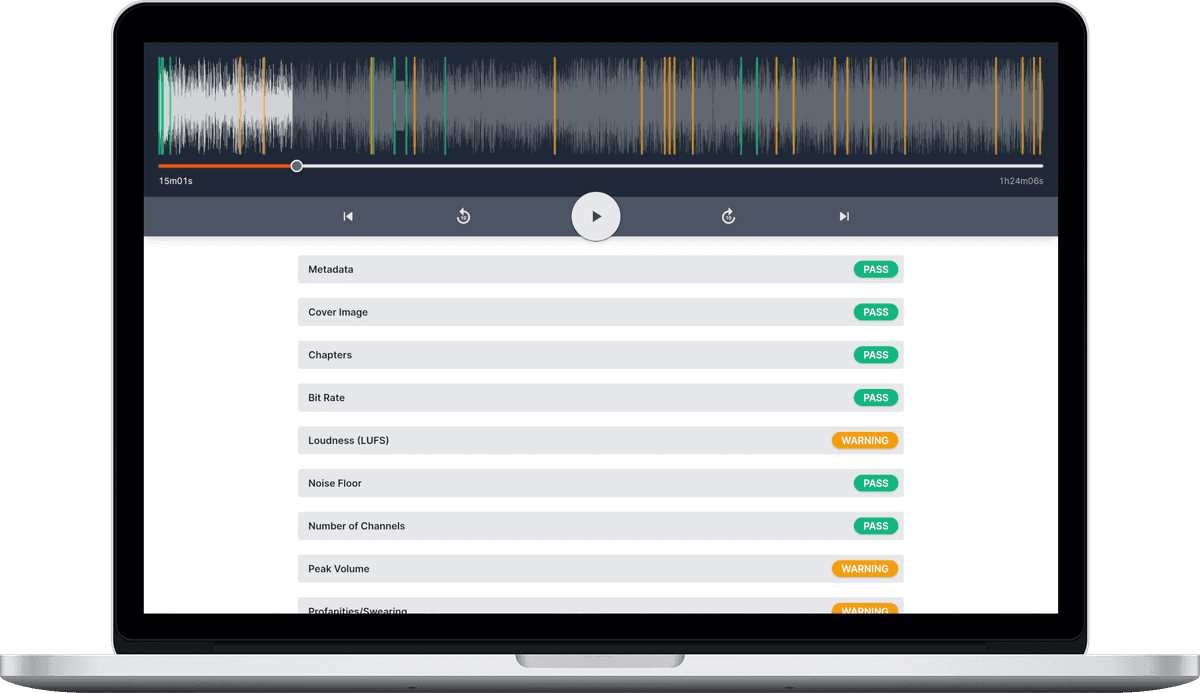
Sign up
Creating an account takes less than a minute. You start on the free plan — about an hour of audio a month, no credit card needed — and go straight to your dashboard to upload audio or connect your podcast’s feed.