Descript vs. Audio Audit (comparison)
 Damian Moore, Last updated: 15 October 2026
Descript and Audio Audit sit at different points in the same job. Descript is where you make the episode. Audio Audit is where you check it — before it goes out, and after.
Descript is a text-based editor: it transcribes your recording and then lets you cut the audio and video by editing the transcript, with a stack of AI tools on top — Studio Sound for cleaning up the sound, one-click removal of filler words, silences and bad takes, multitrack sequences, scenes, captions and screen recording. Audio Audit started life as the other half of that job — checking a finished episode is up to standard, marking what’s wrong and where, and keeping an eye on your feed afterwards — and as of August 2026 it fixes things too. With Enhancements, it applies noise reduction, speech levelling, loudness normalisation and clean metadata, and then you re-run the report to prove the numbers actually moved. Analyse, fix, verify.
The short version: Descript is a place you work in; Audio Audit is a pass you run over what came out of it.
This page was last fact-checked against descript.com in August 2026.
Comparison Overview
File and Metadata Checks
| Feature | Descript | Audio Audit |
|---|---|---|
| Metadata checking | ❌ No | ✅ Yes |
| Cover art checking | ❌ No | ✅ Yes |
| Chapter checking | ❌ No, though it writes chapters on export | ✅ Yes |
| Bit-rate checking | ❌ No | ✅ Yes |
| Sample-rate checking | ❌ No | ✅ Yes |
| Sample-width checking | ❌ No | ✅ Yes |
| Channel count checking (stereo/mono) | ❌ No | ✅ Yes |
Analysis and Detection
| Feature | Descript | Audio Audit |
|---|---|---|
| LUFS/loudness checking | ❌ No, real-time dB meter only | ✅ Yes |
| Peak volume checking | ❌ No, real-time clip warning only | ✅ Yes |
| Noise floor checking | ❌ No | ✅ Yes |
| Unwanted noise detection (coughs, knocks, pets, etc.) | ❌ No, Studio Sound reduces noise rather than flagging it | ✅ Yes, dozens of noise types |
| Filler word detection (uhm, ahh, etc.) | ✅ Yes, English transcripts only | ❌ No |
| Long silence detection | ✅ Yes, word gaps are found and searchable | ✅ Yes |
| Restarted sentence detection | ✅ Yes (Remove Retakes) | ✅ Yes |
| Swearing detection | ✅ Yes, Underlord can bleep profanity on request | ✅ Yes |
| Automatic transcriptions | ✅ Yes, 25+ languages | ✅ Yes |
Enhancement and Editing
| Feature | Descript | Audio Audit |
|---|---|---|
| Audio file modification | ✅ Yes | ✅ Yes (Enhancements) |
| One-pass enhancement of a finished episode | ✅ Yes (Studio Sound), inside a Descript project | ✅ Yes — measured processing, no generative AI |
| Noise reduction | ✅ Yes (Studio Sound), plus echo | ✅ Yes, profile measured from your recording |
| Speech levelling (compression) | ✅ Yes, Studio Sound smooths inconsistent audio across speakers | ✅ Yes |
| Loudness normalisation (LUFS targets) | ✅ Yes, -14 to -24 LUFS presets on export | ✅ Yes, presets for podcasts, YouTube and ACX |
| Metadata & cover art writing | ✅ Yes, on export (no artwork/chapters in .wav) | ✅ Yes, without re-encoding audio |
| Automatic filler word removal | ✅ Yes | ❌ No |
| Automatic silence removal | ✅ Yes | ❌ No |
| Transcript-based editing | ✅ Yes | ❌ No |
Monitoring and Reporting
| Feature | Descript | Audio Audit |
|---|---|---|
| Automatic reports by email | ❌ No | ✅ Yes |
| RSS feed monitoring | ❌ No, publishes to hosts but doesn’t watch feeds | ✅ Yes |
| Scoring over the long-term across shows and team members | ❌ No | ✅ Yes |
Plans and Pricing
| Feature | Descript | Audio Audit |
|---|---|---|
| Free trial | ❌ No, but there is a free plan | ✅ Yes |
| Free tier | ✅ Yes, 1 media hour a month | ✅ Yes, free credits every month |
| Pricing model | Subscription — free plan, then monthly or annual tiers | Pay-as-you-go credits or subscription — see /pricing |
| One-off credit top-ups (no subscription needed) | ❌ No — top ups need a Creator or Business plan | ✅ Yes — credit packs valid 12 months |
Editing: Descript Wins, And It Isn’t Close
Let’s get the honest part out of the way first. Descript’s core trick — delete a word in the transcript and the audio goes with it — is still the fastest way most people will ever cut a spoken-word recording, and everything it has built on top of that is genuinely useful:
- Filler words are detected automatically and underlined in the script, and you can clear them in bulk from the AI Tools panel. English transcripts only, at the time of writing.
- Remove silence, added in Descript 3.7, strips the dead air out of a recording in one pass with an adjustable threshold, and Shorten word gaps does the same job on individual pauses.
- Remove Retakes lets you record a line as many times as you like and then drop the bad takes in a click.
- Around all of that sit a 5-band parametric EQ, ducking, AI-matched room tone to smooth over edits, multitrack sequences, video scenes, captions, browser-based remote recording and direct publishing to Buzzsprout, Captivate, Podbean, Transistor, Castos and others.
Audio Audit does none of this, and we have no plans to bluff at it. There is no editor, no timeline, no transcript you can cut. We detect long silences and restarted sentences and mark them with timestamps so you know how much of a problem you have and where it is, but you go and cut them somewhere else — in Descript, quite possibly. Detection and removal are different jobs, and we only do the first one. Filler words we don’t detect at all; Descript finds those for you in the script.
Studio Sound and Noise Reduction
Studio Sound is Descript’s one-knob answer to bad sound: “an AI-powered audio effect that enhances spoken voice by reducing background noise, echo, and other distractions”, with an Intensity slider to decide how much of it you want. It is very good at what it does, and it is broader than ours in one important way — it takes echo out of a boxy room. We don’t do reverb removal at all.
Audio Audit comes at noise from two directions, and it’s worth being clear about which does what. First, detection: it measures the background noise floor so you can see when a signal is simply too dirty to save, and an AI classifier that recognises dozens of types of unwanted noise marks the one-off events — coughs, sneezes and children, through to engines, car alarms, sirens and phone notifications. Detection tells you what is wrong and where, down to the timestamp, and leaves the decision to you. Sometimes a noise is ambience and you’ll want to keep it.
Second, enhancement removes the constant background for you. Noise reduction builds a noise profile from the quietest moments of your recording — your room’s particular hum, hiss and air conditioning rather than a generic guess — and subtracts it frequency by frequency, with a soft gate that lowers the level between phrases instead of hard-muting them, so pauses still sound like a room rather than a void. It is deliberately capped at 12 dB, safely below the point where spectral processing on speech starts to sound underwater. If your recording is noisier than that, the honest fix is at the source, and we’d rather tell you than quietly make your audio worse.
Descript is candid about the equivalent limit at its end: its own documentation warns that when background noise is extremely loud, Studio Sound may suppress the speech along with it. Every noise tool has that cliff edge. The difference is what you’re given to steer with — an intensity slider on one side, a measured noise floor and a labelled list of events on the other.
Loudness: Descript Hits the Target, But Doesn’t Tell You the Number
This is the part of this page that most needed updating, because Descript handles loudness better than podcasters often realise. Auto-leveling “nudges every clip’s loudness to a consistent target (around -16 dB)” and is on by default, so a project with a loud guest and a quiet host is already partly sorted before you touch anything. And when you export audio, the Normalize volume setting offers Off, Peak, -14, -16, -18, -23 and -24 LUFS. Choose -16 LUFS and your episode leaves Descript at the podcast standard. Credit where it’s due: that is the right target, applied properly, at the right moment.
What Descript doesn’t give you is the number afterwards. Its volume unit meter is a real-time display on a -30 to 0 dB scale for spotting clipping as you play; there is no integrated loudness reading for the finished programme, and no analysis report in the product to put one in. Setting a target is not the same as knowing you hit it — the standards allow ±1 dB of tolerance precisely because tools have to compress or limit to get there.
Audio Audit measures instead of assuming. Volume normalisation ships with presets for podcast platforms (-16 LUFS), YouTube (-14 LUFS) and ACX audiobooks (-19 LUFS), all with true-peak-safe limiting and a custom option if your target is something else. It’s a two-pass measurement built on the same ITU-R BS.1770 loudness model broadcast uses: measure the whole episode, then apply a single constant gain change, so normalisation changes how loud your episode is and never how it breathes. Compression is available alongside it, with the threshold set from your own measured speech level rather than a fixed number.
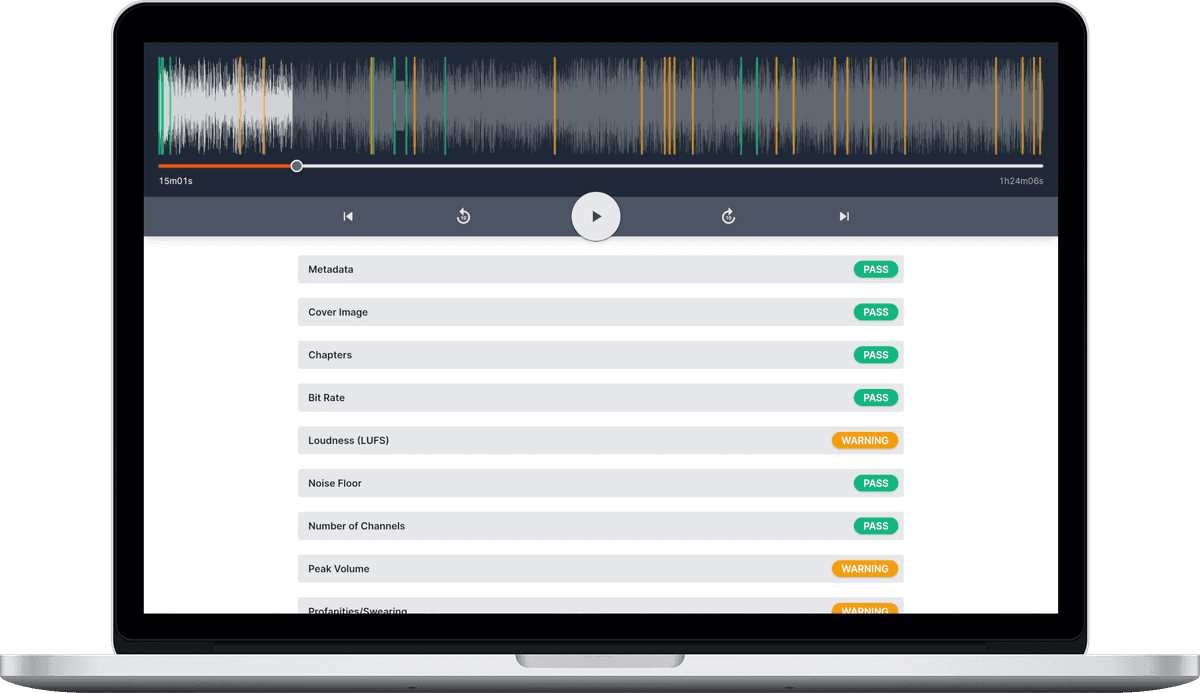
Then the report closes the loop. Run a fresh analysis on the finished file and the loudness figure lands next to the true peak, the noise floor, the metadata and the cover art — a full audit of the artefact, rather than a setting you ticked on the way out of an editor.
What Happens After You Export
Descript sees you all the way to the export dialog, and it finishes well: it writes show title, episode title, description, artwork and chapter markers into the file (WAV excepted, which can’t carry artwork or chapters), and it will push the finished episode straight to your host. As a place to publish from, it’s tidy.
Audio Audit picks up where that stops. It reads the file that exists and tells you whether it’s fit to publish: bit rate, sample rate, sample width, channel count, peak level, noise floor, loudness, swearing, restarted sentences, long silences, missing metadata, cover art that podcast directories will reject. Where a check fails, the enhancement that would fix it comes pre-ticked on the report — and if metadata is the only thing you change, the audio isn’t re-encoded at all.
Then it keeps going. Point Audio Audit at your RSS feed and it re-checks the file your host actually served, which isn’t always the file you uploaded — hosts re-encode, and a re-encode can shift your loudness and clip your peaks long after every tool in your production chain has finished and gone home. Reports arrive by email, scores build up across episodes, shows and team members, and the trend tells you whether your audio is quietly getting worse. None of that exists in Descript, because none of it is what Descript is for.
Paying For It
Descript is a subscription, and the tiers have moved a long way since this page was first written. As of August 2026 there’s a free plan — 1 media hour a month, 100 one-time AI credits, 720p video exports with a watermark and 5 GB of storage — and then Hobbyist at $24 a month, or $16 a month billed annually ($192 a year); Creator at $35 a month, or $24 a month annually ($288 a year); Business at $65 a month, or $50 a month annually ($600 a year); and Enterprise on request. The AI features draw on a separate AI credit allowance, with Studio Sound and filler-word removal capped at 30 credits per file each. Check descript.com/pricing for today’s figures rather than trusting this paragraph in a year’s time.
Descript does sell top ups — extra media hours and AI credits, expiring 12 months after purchase, which is exactly the shelf life of ours. The catch is the fine print: top ups are only available on the Creator and Business plans. There’s no way to hand Descript money for a single episode’s worth of processing without holding a subscription first.
Audio Audit runs on credits, with free credits every month, monthly plans if your usage is steady, and one-off top-up packs valid for 12 months if it isn’t. Reports and enhancements draw on the same balance — a full clean-up costs about the same per minute as a full standard analysis — and you see the estimate before you commit. Current prices live on the pricing page rather than in this article, because comparison pages go stale and pricing pages don’t.
So the practical difference is about commitment rather than headline price. Descript is a tool you subscribe to and keep subscribing to for as long as you’re making episodes, which is a perfectly reasonable deal for something you open every week. Audio Audit is happy to be occasional: buy a pack of credits, check and fix the episode in front of you, and come back in three months if that’s when you next need it.
So Which One?
If you’re making the episode — cutting it, tightening it, taking the ums out, doing anything with video — use Descript. Text-based editing is a genuinely better way to work, and nothing in Audio Audit competes with it or tries to.
If you want to know whether the finished file is actually up to standard, with the measurements to back it up, fix the specific things that aren’t, confirm the numbers moved, and then keep an eye on every episode you publish from here on, that’s Audio Audit.
The two go together more naturally than most pairs on this site: edit and export from Descript, then run the file through Audio Audit before it goes live — and again on the feed once your host has had its turn with it.
Want the full detail on what Audio Audit’s enhancements do? See the Enhancements announcement and the Enhancing Audio guide, or head to the Pricing page to see what a report or an enhancement costs for your episode length. Comparing other tools too? We’ve written the same honest breakdown for Auphonic, Adobe Podcast Enhance and Cleanvoice.
Photos courtesy of Jeremy Thomas