Cleanvoice vs. Audio Audit (comparison)
 Damian Moore, Last updated: 29 August 2026
Cleanvoice and Audio Audit work the same way from the outside. You upload a finished recording, a machine does something to it, you download a better file, and you pay for the minutes you used rather than signing up for anything monthly. Same shape, same kind of bill. What comes back is different.
Cleanvoice is an automated podcast editor: it finds the ums, the lip smacks, the stutters and the breaths in your recording and cuts them out, shortens the long silences, cleans up the background noise, and hands you back an episode — plus a transcript, show notes, chapter markers and social posts if you want them. Audio Audit started life as the other half of that job — checking a finished episode is up to standard, marking what’s wrong and where, and keeping an eye on your feed afterwards — and as of August 2026 it fixes things too. With Enhancements, it applies noise reduction, speech levelling, loudness normalisation and clean metadata, and then you re-run the report to prove the numbers actually moved. Analyse, fix, verify.
The short version: Cleanvoice takes things out of your episode; Audio Audit measures what’s left and tells you whether it’s fit to publish.
This page was last fact-checked against cleanvoice.ai in August 2026.
Comparison Overview
File and Metadata Checks
| Feature | Cleanvoice | Audio Audit |
|---|---|---|
| Metadata checking | ❌ No | ✅ Yes |
| Cover art checking | ❌ No | ✅ Yes |
| Chapter checking | ❌ No, though Summary writes chapter markers for your show notes | ✅ Yes |
| Bit-rate checking | ❌ No | ✅ Yes |
| Sample-rate checking | ❌ No | ✅ Yes |
| Sample-width checking | ❌ No | ✅ Yes |
| Channel count checking (stereo/mono) | ❌ No | ✅ Yes |
Analysis and Detection
| Feature | Cleanvoice | Audio Audit |
|---|---|---|
| LUFS/loudness checking | ❌ No, it normalises without reporting the figure | ✅ Yes |
| Peak volume checking | ❌ No | ✅ Yes |
| Noise floor checking | ❌ No, though Cleanscore rates how noisy a show is | ✅ Yes |
| Unwanted noise detection (coughs, knocks, pets, etc.) | ❌ No, noise is removed rather than flagged | ✅ Yes, dozens of noise types |
| Filler word detection (uhm, ahh, etc.) | ✅ Yes, twelve languages confirmed | ✅ Yes |
| Long silence detection | ✅ Yes, dead air is found and shortened | ✅ Yes |
| Restarted sentence detection | ❌ No, though stutter removal catches repeated words | ✅ Yes |
| Swearing detection | ❌ No | ✅ Yes |
| Automatic transcriptions | ✅ Yes, 99 languages via Whisper | ✅ Yes |
Enhancement and Editing
| Feature | Cleanvoice | Audio Audit |
|---|---|---|
| Audio file modification | ✅ Yes | ✅ Yes (Enhancements) |
| One-pass enhancement of a finished episode | ✅ Yes, everything you tick runs in one pass | ✅ Yes — measured processing, no generative AI |
| Noise reduction | ✅ Yes, plus echo and reverb | ✅ Yes, profile measured from your recording |
| Speech levelling (compression) | ✅ Yes, levels balanced across speakers and segments | ✅ Yes |
| Loudness normalisation (LUFS targets) | ✅ Yes, matched to podcast targets automatically; custom target via the API | ✅ Yes, presets for podcasts, YouTube and ACX |
| Metadata & cover art writing | ❌ No | ✅ Yes, without re-encoding audio |
| Automatic filler word removal | ✅ Yes | ❌ No |
| Automatic silence removal | ✅ Yes | ❌ No |
| Transcript-based editing | ❌ No, deliberately — it edits the audio, not a transcript | ❌ No |
Monitoring and Reporting
| Feature | Cleanvoice | Audio Audit |
|---|---|---|
| Automatic reports by email | ❌ No, job completion emails only | ✅ Yes |
| RSS feed monitoring | ❌ No, though Cleanscore audits a show’s latest episode on request | ✅ Yes |
| Scoring over the long-term across shows and team members | ❌ No, Cleanscore scores one episode at a time | ✅ Yes |
Plans and Pricing
| Feature | Cleanvoice | Audio Audit |
|---|---|---|
| Free trial | ✅ Yes, 30 minutes free, no card | ✅ Yes |
| Free tier | ❌ No, the free minutes are one-off | ✅ Yes, free credits every month |
| Pricing model | Pay-as-you-go credit packs or subscription | Pay-as-you-go credits or subscription — see /pricing |
| One-off credit top-ups (no subscription needed) | ✅ Yes — credit packs valid 2 years | ✅ Yes — credit packs valid 12 months |
Fillers, Mouth Sounds and Dead Air: Cleanvoice Wins This Outright
Let’s start where Cleanvoice is simply better, because it isn’t close and pretending otherwise would waste your time.
Cleanvoice’s whole reason to exist is taking the fluff out of spoken word, and it does it across a genuinely useful spread of problems:
- Filler words — every “um”, “uh” and “like”, found and cut. The marketing promises 20+ languages; the developer documentation is more precise and lists twelve confirmed to work well, including German, Spanish, Italian, Portuguese, Dutch, Polish, Romanian, Arabic, Turkish and Bulgarian. (Their own filler-words page still names only five, so the documentation is the figure to trust — and worth checking for your language before you commit.) Detection is phonetic rather than text-based, so close relatives of those languages tend to work too. If your show isn’t in English, that’s a bigger deal than a line on a feature list makes it sound.
- Mouth sounds and breaths — clicks, lip smacks and tongue noises, with breath removal offered in three flavours: the recommended setting, a conservative “legacy” one for already-clean audio, and a “natural” one that leaves more of your breathing in.
- Stutters — and the implementation detail is a nice one: “We first try to identify the stutter. Once we identify it, we try to edit out the stutter without cutting the word out.”
- Dead air — shortened rather than deleted, and shortened contextually: “When the speaker is thinking, we make the pause short. If the speaker changes topic, we keep the pause longer.”
Around that sit the things that make it practical on a real show. It edits multitrack recordings — five tracks as standard, and more if you write and ask — and keeps every speaker in sync. It will mute the edits instead of cutting them, which keeps your audio lined up with video. It does video podcasts. And if you’d rather not let a machine touch the master, it will hand you the edit decisions instead: markers and timestamps you can load into Audition, Premiere, DaVinci Resolve, Reaper, Audacity or anything that reads an EDL, then approve or fine-tune each cut yourself.
One thing it pointedly doesn’t do is make you work through a transcript first. It will transcribe your episode — 99 languages, via Whisper — and summarise it into show notes, chapters and social posts, but the editing itself happens on the audio: “unlike other AI podcast editors, Cleanvoice doesn’t work based on the transcript-to-edit flow. You only need to upload your files.” If you’ve been put off text-based editors, that’s the pitch.
Audio Audit does none of this, and we have no plans to bluff at it. There is no editor and no timeline. We detect filler words and long silences and mark them with timestamps so you know how much of a problem you have and where it is, but you go and cut them somewhere else — in Cleanvoice, quite possibly. Detection and removal are different jobs, and we only do the first one.
Noise: Two Different Aims
Cleanvoice’s noise removal is on by default and it is broad. In its own words it removes “heavy background noise, wind noise, ambient noise, static and mic noise, buzz sounds, hiss, hum, puffs, and more”, and it will take out “echo, reverb, distortion” as well. Turn on Studio Sound and it goes further again — its own guide describes that as auto-applying EQ, brightening or smoothing your voice and removing reverb, “making you sound studio-recorded”. There’s also a “keep music” option so a noise pass doesn’t chew through your intro bed. We don’t do reverb removal at all, and there’s no EQ in Audio Audit.
Audio Audit comes at noise from two directions, and it’s worth being clear about which does what. First, detection: it measures the background noise floor so you can see when a signal is simply too dirty to save, and an AI classifier that recognises dozens of types of unwanted noise marks the one-off events — coughs, sneezes and children, through to engines, car alarms, sirens and phone notifications. Detection tells you what is wrong and where, down to the timestamp, and leaves the decision to you. Sometimes a noise is ambience and you’ll want to keep it.
Second, enhancement removes the constant background for you. Noise reduction builds a noise profile from the quietest moments of your recording — your room’s particular hum, hiss and air conditioning rather than a generic guess — and subtracts it frequency by frequency, with a soft gate that lowers the level between phrases instead of hard-muting them, so pauses still sound like a room rather than a void. It is deliberately capped at 12 dB, safely below the point where spectral processing on speech starts to sound underwater. If your recording is noisier than that, the honest fix is at the source, and we’d rather tell you than quietly make your audio worse.
Cleanvoice is candid about its own edge cases in the same spirit: its dead-air documentation notes that on extremely noisy audio you’re better off running a noise-removal pass before asking it to find your pauses. Every tool in this space has a cliff edge somewhere. The difference is what you’re given to steer with — a set of templates on one side, a measured noise floor and a labelled list of events on the other.
Loudness: Both of Us Hit the Target, Only One of Us Shows You the Number
The standard loudness for podcasts is -16 LUFS, and our customers tell us it’s the number one thing they’re checking their reports for.
Credit where it’s due, because this one surprises people: Cleanvoice normalises properly. Its Normalize option “balances loudness levels across your entire file to hit podcast-standard targets like -16 LUFS”, and its own guide to podcast loudness says your audio is “automatically matched to platform targets (like Apple Podcasts’ -16 LUFS)” with “no need to set LUFS manually”. Developers get finer control than the app does: the API takes a target_lufs value, with -16 documented as the podcast standard. That is the right target, applied at the right moment, and it’s more than most one-click clean-up tools bother with.
What you don’t get back is the figure. When a Cleanvoice job finishes, the result carries your cleaned file, a waveform, and — if you asked for them — a transcript, a summary and social copy. There’s no integrated loudness reading in it, no true-peak number and no analysis report to put them in. Setting a target is not the same as knowing you hit it: the standards allow ±1 dB of tolerance precisely because tools have to compress or limit to get there.
Audio Audit measures instead of assuming. Volume normalisation ships with presets for podcast platforms (-16 LUFS), YouTube (-14 LUFS) and ACX audiobooks (-19 LUFS), all with true-peak-safe limiting and a custom option if your target is something else. It’s a two-pass measurement built on the same ITU-R BS.1770 loudness model broadcast uses: measure the whole episode, then apply a single constant gain change, so normalisation changes how loud your episode is and never how it breathes. Compression is available alongside it, with the threshold set from your own measured speech level rather than a fixed number.
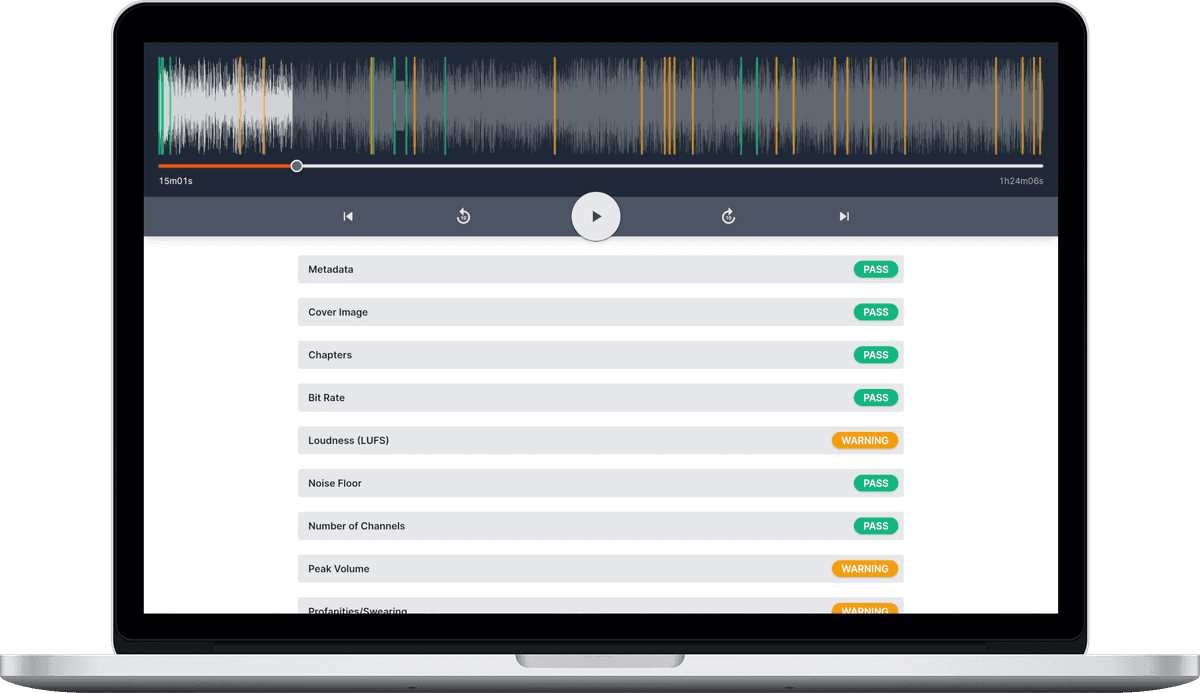
Then the report closes the loop. Run a fresh analysis on the finished file and the loudness figure lands next to the true peak, the noise floor, the metadata and the cover art — a full audit of the artefact, rather than a setting you ticked on the way through a clean-up.
Cleanscore, and What Else an Audit Covers
Cleanvoice does have an audit tool, and it deserves more than a footnote. Cleanscore is free of charge: search for your show, and it downloads your latest episode, runs the Cleanvoice models over it and gives you a score with a breakdown. It grades the things it knows how to fix — factors like stuttering, filler words and background noise — and it adjusts for episode length so a long show isn’t punished for having more of everything. If nobody has ever told you how your delivery lands, ten minutes with Cleanscore is time well spent.
Audio Audit’s report is a different instrument, pointed at the file rather than the performance. It reads the file that exists and tells you whether it’s fit to publish: bit rate, sample rate, sample width, channel count, peak level, noise floor, loudness, swearing, restarted sentences, filler words, long silences, missing metadata, cover art that podcast directories will reject. Where a check fails, the enhancement that would fix it comes pre-ticked on the report — and if metadata is the only thing you change, the audio isn’t re-encoded at all. Tags and embedded artwork are the quiet one there: Cleanvoice hands back a cleaned audio file, and nothing in it writes your episode title, artist, copyright or cover art into the tags, because that was never the job it took on.
Then it keeps going. Point Audio Audit at your RSS feed and it re-checks the file your host actually served, which isn’t always the file you uploaded — hosts re-encode, and a re-encode can shift your loudness and clip your peaks long after every tool in your production chain has finished and gone home. Reports arrive by email, scores build up across episodes, shows and team members, and the trend tells you whether your audio is quietly getting worse. Cleanscore is a snapshot you go and ask for; this is a standing check on everything you publish.
Paying For It
Here’s where the two products have quietly converged, so let’s be straight about it: both of us sell credits, both of us have a subscription for people who want one, and neither of us makes you take out a monthly plan to fix a single episode. On the pricing model itself, this is parity.
Cleanvoice bills by the hour of processed audio, and every paid plan includes every feature — you’re not paying more for ticking more boxes, though the free trial is limited to what Cleanvoice calls basic features. As of August 2026, pay-as-you-go packs are $11 for 5 hours, $20 for 10 hours and $45 for 30 hours (that’s $2.20 down to $1.50 an hour), and the credits are valid for two years. Subscriptions start at $11 a month for 10 hours and run to $90 a month for 100, annual billing knocks that down further, and unused subscription credits roll over up to three times your monthly allowance. Billing is by the duration of the file, rounded up to the minute, with a one-minute minimum — so a 10-minute-20-second file is billed as 11 minutes. Prices are quoted without VAT and there’s a euro price list too. Check cleanvoice.ai/pricing for today’s figures rather than trusting this paragraph in a year’s time.
You can also try it without handing over anything: 30 minutes free, no card — and without signing up at all. Create an account and you get another 30 minutes of free credits on top. What there isn’t is a recurring free allowance — the free minutes are a one-off, not a monthly refill.
Audio Audit runs on credits, with free credits every month, monthly plans if your usage is steady, and one-off top-up packs valid for 12 months if it isn’t. Reports and enhancements draw on the same balance — a full clean-up costs about the same per minute as a full standard analysis — and you see the estimate before you commit. Current prices live on the pricing page rather than in this article, because comparison pages go stale and pricing pages don’t.
Two honest points for Cleanvoice while we’re here. Their credits outlast ours — two years against our twelve months — so if your podcasting is genuinely occasional, that’s a point in their favour. And their one-minute billing minimum is kinder than our ten-minute one if you’re processing short clips rather than episodes.
The difference worth weighing isn’t the pack, it’s what the credits buy. A Cleanvoice hour buys you processing, with the whole toolbox included. An Audio Audit credit buys you the analysis, the fix and the ongoing feed monitoring from one balance — so the tool that found the problem is the tool that fixes it and the tool that confirms it’s gone.
So Which One?
If your recordings are full of ums, clicks, stutters and long thinking pauses — or your show is in German, Portuguese or Polish and the English-only tools have been no use to you — use Cleanvoice. Cutting that material out by hand is miserable work, it does the job in one pass across every speaker’s track, and it will hand you the edit list if you’d rather make the final call yourself.
If you want to know whether the finished file is actually up to standard, with the measurements to back it up, fix the specific things that aren’t, confirm the numbers moved, and then keep an eye on every episode you publish from here on, that’s Audio Audit.
And they chain together neatly, because the credits work the same way at both ends. Clean the recording in Cleanvoice, then run the result through Audio Audit to normalise it to -16 LUFS, write the tags and cover art, and check the finished file against everything a directory cares about — followed by one more look at the feed, once your host has had its turn with it.
Want the full detail on what Audio Audit’s enhancements do? See the Enhancements announcement and the Enhancing Audio guide, or head to the Pricing page to see what a report or an enhancement costs for your episode length. Comparing other tools too? We’ve written the same honest breakdown for Auphonic, Descript and Adobe Podcast Enhance.
Photos courtesy of Ze Paulo