iZotope RX 12 vs. Audio Audit (comparison)
 Damian Moore, Last updated: 15 October 2026
iZotope RX is where audio goes when something has gone badly wrong. It’s the repair suite the film and post-production world treats as standard equipment — a spectral editor where you can see a cough and paint it out, plus fifty-odd tools with names like De-click, De-hum, De-reverb and Dialogue Isolate — and RX 12, released in spring 2026, rebuilt its headline machine-learning tools to be markedly better and markedly faster. If an episode is genuinely damaged, there is no better place to take it.
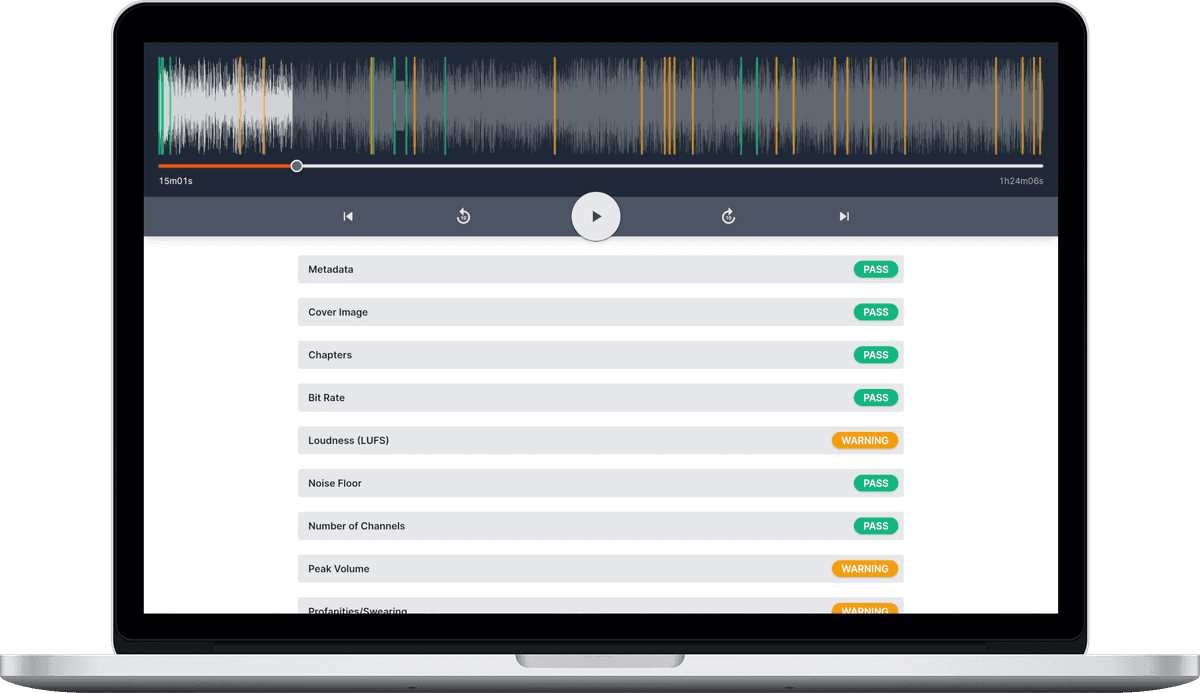
Audio Audit is the routine check-up to RX’s emergency room. It reads the finished episode, measures whether it’s fit to publish — loudness, true peak, noise floor, bit rate, metadata, artwork, and the content problems with timestamps — fixes the ordinary things via Enhancements (noise reduction, speech levelling, loudness normalisation, clean metadata), and then keeps checking your feed after you publish. Analyse, fix, verify — and, crucially, tell you whether you need the emergency room at all.
The short version: RX repairs audio brilliantly, one file at a time, by hand; Audio Audit inspects, fixes and monitors your podcast as a routine — and costs less than RX’s cheapest box.
This page was last fact-checked against izotope.com in September 2026.
Comparison Overview
File and Metadata Checks
| Feature | iZotope RX 12 | Audio Audit |
|---|---|---|
| Metadata checking | ❌ No | ✅ Yes |
| Cover art checking | ❌ No | ✅ Yes |
| Chapter checking | ❌ No | ✅ Yes |
| Bit-rate checking | ❌ No | ✅ Yes |
| Sample-rate checking | ❌ No, Resample converts rather than checks | ✅ Yes |
| Sample-width checking | ❌ No | ✅ Yes |
| Channel count checking (stereo/mono) | ❌ No | ✅ Yes |
Analysis and Detection
| Feature | iZotope RX 12 | Audio Audit |
|---|---|---|
| LUFS/loudness checking | ✅ Yes — Loudness Control’s readings, on Standard and Advanced (not the $99 Elements) | ✅ Yes |
| Peak volume checking | ✅ Yes, on Standard and Advanced | ✅ Yes |
| Noise floor checking | ❌ No, noise profiles are learned for reduction, not reported | ✅ Yes |
| Unwanted noise detection (coughs, knocks, pets, etc.) | ❌ No flagged list — Repair Assistant proposes fixes rather than a report | ✅ Yes, dozens of noise types |
| Filler word detection (uhm, ahh, etc.) | ❌ No | ❌ No |
| Long silence detection | ❌ No, Trim Silence (Advanced) cuts rather than flags | ✅ Yes |
| Restarted sentence detection | ❌ No | ✅ Yes |
| Swearing detection | ❌ No | ✅ Yes |
| Automatic transcriptions | ❌ Not as a deliverable — Text Navigation (Standard+) transcribes so you can click around the audio | ✅ Yes |
Enhancement and Editing
| Feature | iZotope RX 12 | Audio Audit |
|---|---|---|
| Audio file modification | ✅ Yes | ✅ Yes (Enhancements) |
| One-pass enhancement of a finished episode | ✅ Yes — Repair Assistant listens and proposes a repair chain, on every tier | ✅ Yes — measured processing, no generative AI |
| Noise reduction | ✅ Yes, the industry’s deepest — spectral de-noise, De-hum, De-reverb, Dialogue Isolate by tier | ✅ Yes, profile measured from your recording |
| Speech levelling (compression) | ✅ Yes on Standard and Advanced, via Loudness Control and the dialogue tools | ✅ Yes |
| Loudness normalisation (LUFS targets) | ✅ Yes on Standard and Advanced — presets and readings; ❌ nothing in Elements | ✅ Yes, presets for podcasts, YouTube and ACX |
| Metadata & cover art writing | ❌ No | ✅ Yes, without re-encoding audio |
| Automatic filler word removal | ❌ No | ❌ No |
| Automatic silence removal | ✅ Yes, Trim Silence — Advanced only | ❌ No |
| Transcript-based editing | ❌ No, Text Navigation navigates rather than edits | ❌ No |
Monitoring and Reporting
| Feature | iZotope RX 12 | Audio Audit |
|---|---|---|
| Automatic reports by email | ❌ No | ✅ Yes |
| RSS feed monitoring | ❌ No | ✅ Yes |
| Scoring over the long-term across shows and team members | ❌ No | ✅ Yes |
Plans and Pricing
| Feature | iZotope RX 12 | Audio Audit |
|---|---|---|
| Free trial | ✅ Yes, a short full-featured trial | ✅ Yes |
| Free tier | ❌ No | ✅ Yes, free credits every month |
| Pricing model | Perpetual licences — Elements $99, Standard $399, Advanced $1,399 — or iZotope’s subscription bundles from $15/month | Pay-as-you-go credits or subscription — see /pricing |
| One-off credit top-ups (no subscription needed) | ❌ Not applicable — though the perpetual licences are one-off buys | ✅ Yes — credit packs valid 12 months |
The Emergency Room for Audio
Let’s give RX its full due, because nothing else on this site’s comparison shelf operates at its level of repair. The spectral editor shows you audio as a picture — every cough, chair squeak and phone buzz visible — and lets you select and repair it the way you’d retouch a photograph. Dialogue Isolate, rebuilt on new neural networks in RX 12, pulls a voice cleanly out of noise that would have been fatal a few years ago; one veteran reviewer called the new separation quality “as convincing as any I’ve heard”. Repair Assistant will listen to your file and propose a whole chain of fixes with adjustable dials, on every tier including the cheapest. This is the tool professional post houses reach for, and when a podcast episode is genuinely wrecked — the interview of a lifetime recorded next to a building site — RX is the honest recommendation, and we’ll happily make it.
Audio Audit isn’t a repair suite and has no plans to bluff at it. Our enhancement is deliberately narrow and deliberately measured: noise reduction profiled from your own recording and capped at 12 dB — safely below the point where spectral processing on speech starts to sound underwater — speech levelling from your measured speech level, loudness normalisation to a target you choose, metadata written without re-encoding. RX will go far deeper on a damaged file. We stop where subtraction stops working, and we tell you so.
The $99 Question: What Elements Actually Contains
Here’s the part the “RX for podcasters” advice usually skips. The tier podcasters are pointed at — RX Elements, $99 — contains exactly six things: De-click, De-clip, De-hum, De-reverb, Voice De-noise and Repair Assistant, as plugins only. No standalone editor. No spectral repair. No batch processing. No Dialogue Isolate. And — the one that matters most for this site — no Loudness Control: the $99 box cannot measure or target loudness at all. The genuinely excellent loudness tooling, with broadcast presets, detailed level readings and RX 12’s new Streaming Preview for auditioning against platform normalisation, starts at RX Standard: $399.
The standard loudness for podcasts is -16 LUFS, and our customers tell us it’s the number one thing they check their reports for. With RX Standard, a skilled user can measure it and conform to it, properly. With Elements, they can’t see it. With Audio Audit — for less than the price of Elements’ box, and with free credits every month before you spend anything — every report carries the integrated loudness, the true peak and the noise floor of the finished file, and the normalisation preset to fix it sits one tick away, verified by re-running the report. It’s the same ITU-R BS.1770 model broadcast uses: measure the whole episode, apply one constant gain change, never touch how the audio breathes.
Repair Is Not a Report
Even at the Advanced tier, RX’s posture is fix-first: Repair Assistant proposes a chain, you audition it, you render. What never appears is the audit artefact — a findings list with timestamps, a document that says here is what’s wrong and where. There’s no cough-at-14:32 report, no restarted sentences, no swearing flag, no metadata or artwork check, and nothing that reads the file the way a podcast directory will. Reviewers of RX 12 are consistent on the deeper point: it’s a corrective tool, superb within that lane, and pushing its processing hard introduces artifacts rather than polish. Every repair tool has that cliff edge; the difference is whether anything tells you where you’re standing.
That’s the half Audio Audit was built for. The report reads the finished episode and marks everything — technical and content — with the failing checks’ fixes pre-ticked, and if metadata is the only thing you change, the audio isn’t re-encoded at all. Detection tells you what is wrong and where, and leaves the judgement calls, and the trips to the emergency room, to you.
After the Rescue
RX’s involvement ends when you render the repaired file. Nothing in it watches what happens next — and what your host serves isn’t always what you rendered. Hosts re-encode, and a re-encode can shift your loudness and clip your peaks long after the most careful RX session is over. Point Audio Audit at your RSS feed and it re-checks the file your host actually served, episode after episode, with reports by email and scores that build across episodes, shows and team members. A studio that runs client shows through RX would recognise this instantly: it’s the QC log, kept automatically.
Paying For It
RX 12 sells as perpetual licences: Elements at $99, Standard at $399, Advanced at $1,399, with upgrade pricing from earlier versions and a subscription route — iZotope’s bundles at $15 a month (Elements level) or $25 (Standard level) — plus a short full trial. Check izotope.com for today’s figures rather than trusting this paragraph in a year’s time. One 2026 footnote worth knowing: iZotope changed hands twice in three months this year — its parent Native Instruments was sold to InMusic in May, and iZotope itself was then carved out to Boris FX in July. The new owners say licences and development continue uninterrupted, and RX 12’s release supports that; it’s simply worth knowing whose ecosystem you’re buying into, because it moved twice while this article was being researched.
Audio Audit runs on credits, with free credits every month, monthly plans if your usage is steady, and one-off top-up packs valid for 12 months if it isn’t. Reports and enhancements draw on the same balance — a full clean-up costs about the same per minute as a full standard analysis — and you see the estimate before you commit. Current prices live on the pricing page rather than in this article, because comparison pages go stale and pricing pages don’t.
So Which One?
If your recordings genuinely need rescue — damaged tape, impossible locations, a client’s unrepeatable interview — buy RX, and buy Standard rather than Elements if loudness matters to you, because the $99 tier can’t see it. It’s the best repair tool in the business, and podcasting is lucky to be able to borrow it.
If you want to know whether each episode is actually up to standard — the measurements in one report, the everyday fixes applied and verified, and your feed watched from then on — that’s Audio Audit, at a fraction of the price and none of the learning curve.
And the chain writes itself: run the report first. Most weeks it will tell you the episode needs nothing more than normalisation and tags — done in one pass, verified. The week it shows a noise floor through the ceiling and a list of events no ordinary clean-up will fix, that’s your trip to the emergency room — and when RX has done its work, the fresh report is how you prove the patient recovered.
Want the full detail on what Audio Audit’s enhancements do? See the Enhancements announcement and the Enhancing Audio guide, or head to the Pricing page to see what a report or an enhancement costs for your episode length. Comparing other tools too? We’ve written the same honest breakdown for Adobe Podcast Enhance, Auphonic, Alitu, Descript and Cleanvoice.
Photos courtesy of Marc Sendra Martorell