Hindenburg PRO vs. Audio Audit (comparison)
 Damian Moore, Last updated: 15 October 2026
Of every editor on this site’s comparison shelf, Hindenburg PRO is the one that cares most about the same things we do. It’s a Danish DAW built by radio journalists for radio journalists — the company’s founding belief is that “stories must be heard” — and it grew up in a world where loudness standards aren’t a nice-to-have, they’re the difference between your piece airing or not. So Hindenburg levels your clips against loudness standards the moment you drop them on the timeline, meters loudness while you work, and masters your export to a compliant target with one button marked “publish”. If you’ve read our pages on tools that never show you a number, this is the opposite kind of tool.
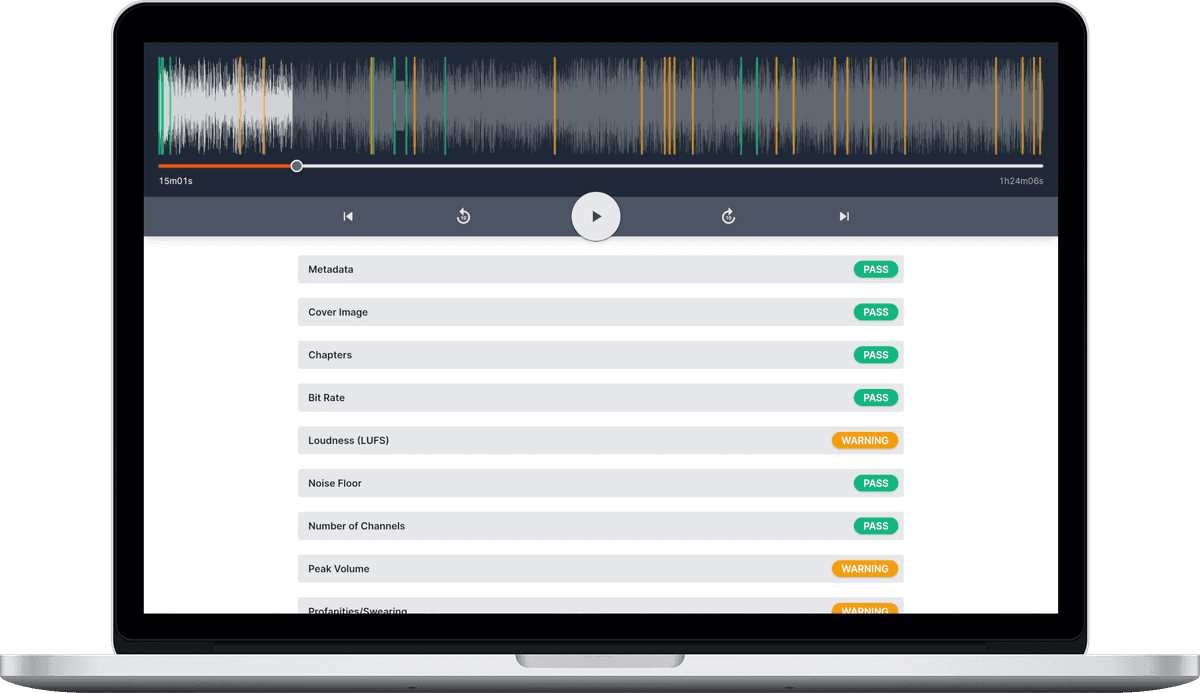
Audio Audit still comes at the job from a different side. Hindenburg is a place you make the episode; Audio Audit reads the finished file — whoever made it, in whatever tool — measures whether it’s fit to publish, fixes the specific things that aren’t, and keeps checking your feed after you’ve moved on. As of August 2026 that includes the fixing: with Enhancements, it applies noise reduction, speech levelling, loudness normalisation and clean metadata, and then you re-run the report to prove the numbers actually moved. Analyse, fix, verify.
The short version: Hindenburg builds your episode to standard; Audio Audit proves any episode meets it — and keeps proving it after publish.
This page was last fact-checked against hindenburg.com in September 2026.
Comparison Overview
File and Metadata Checks
| Feature | Hindenburg PRO | Audio Audit |
|---|---|---|
| Metadata checking | ❌ No, though it writes ID3 tags on export | ✅ Yes |
| Cover art checking | ❌ No | ✅ Yes |
| Chapter checking | ❌ No, though it can write chapters on export | ✅ Yes |
| Bit-rate checking | ❌ No | ✅ Yes |
| Sample-rate checking | ❌ No | ✅ Yes |
| Sample-width checking | ❌ No | ✅ Yes |
| Channel count checking (stereo/mono) | ❌ No | ✅ Yes |
Analysis and Detection
| Feature | Hindenburg PRO | Audio Audit |
|---|---|---|
| LUFS/loudness checking | ✅ Yes, a loudness meter in the editor | ✅ Yes |
| Peak volume checking | ❌ No report, editor metering only | ✅ Yes |
| Noise floor checking | ❌ No | ✅ Yes |
| Unwanted noise detection (coughs, knocks, pets, etc.) | ❌ No, de-bleed and de-noise fix rather than flag | ✅ Yes, dozens of noise types |
| Filler word detection (uhm, ahh, etc.) | ❌ No, you search the transcript yourself | ❌ No |
| Long silence detection | ❌ No | ✅ Yes |
| Restarted sentence detection | ❌ No | ✅ Yes |
| Swearing detection | ❌ No | ✅ Yes |
| Automatic transcriptions | ✅ Yes, 99 languages, processed on your own machine | ✅ Yes |
Enhancement and Editing
| Feature | Hindenburg PRO | Audio Audit |
|---|---|---|
| Audio file modification | ✅ Yes | ✅ Yes (Enhancements) |
| One-pass enhancement of a finished episode | ✅ Yes — Auto Level runs the moment a clip lands | ✅ Yes — measured processing, no generative AI |
| Noise reduction | ✅ Yes, a one-knob de-noise | ✅ Yes, profile measured from your recording |
| Speech levelling (compression) | ✅ Yes — Auto Level and Magic Levels, with automix, de-bleed and ducking | ✅ Yes |
| Loudness normalisation (LUFS targets) | ✅ Yes, standards presets from broadcast to podcast targets | ✅ Yes, presets for podcasts, YouTube and ACX |
| Metadata & cover art writing | ✅ Yes, ID3 tags and chapters on export | ✅ Yes, without re-encoding audio |
| Automatic filler word removal | ❌ No | ❌ No |
| Automatic silence removal | ❌ No | ❌ No |
| Transcript-based editing | ✅ Yes, delete the words and the audio follows | ❌ No |
Monitoring and Reporting
| Feature | Hindenburg PRO | Audio Audit |
|---|---|---|
| Automatic reports by email | ❌ No | ✅ Yes |
| RSS feed monitoring | ❌ No, though it publishes direct to 13+ hosts | ✅ Yes |
| Scoring over the long-term across shows and team members | ❌ No | ✅ Yes |
Plans and Pricing
| Feature | Hindenburg PRO | Audio Audit |
|---|---|---|
| Free trial | ✅ Yes, 30 days | ✅ Yes |
| Free tier | ❌ No | ✅ Yes, free credits every month |
| Pricing model | Subscription from $12/month (or $99/year), plus a personal perpetual licence | Pay-as-you-go credits or subscription — see /pricing |
| One-off credit top-ups (no subscription needed) | ❌ No, though the perpetual licence is a one-off buy | ✅ Yes — credit packs valid 12 months |
An Editor With Radio Discipline
Hindenburg deserves its reputation, so let’s spend a section on why. Auto Level is the headline: drop a clip on the timeline and it’s analysed and levelled against loudness standards immediately — not peak-normalised, properly loudness-levelled — and the newer Magic Levels goes further, folding automix, de-bleed and auto-ducking into the same pass, so a two-microphone kitchen-table recording stops sounding like one. The Voice Profiler is an automated EQ that learns a voice and keeps it consistent across sessions, which is exactly the tool a weekly host needs and almost nobody else ships. Editing works the radio way — a clipboard for building stories from tape — and, since PRO 2, the transcript way too: highlight a sentence, hit delete, and the audio goes with it, in a transcription engine that runs in 99 languages entirely on your own machine, without sending your audio to anyone’s cloud. That last bit matters to newsrooms, and it should matter to more podcasters than it does.
And when the story’s built, one button marked “publish” masters the episode to a compliant loudness target and sends it to your host directly — Hindenburg talks natively to more than a dozen hosting services, from Acast, Buzzsprout and Libsyn to PRX, Podbean and RSS.com. As one long-running review put it, publish “will master the audio to the right loudness level”. For an editor, that is about as standards-minded as it gets.
Audio Audit doesn’t edit anything, and we have no plans to bluff at it. No timeline, no clipboard, no transcript to cut. We detect — long silences, restarted sentences, coughs and car alarms — and mark everything with timestamps so you know how much of a problem you have and where it is. You do the cutting somewhere else. In Hindenburg, quite happily.
Loudness: Hindenburg Does It Right — For Its Own Episodes
The standard loudness for podcasts is -16 LUFS, and our customers tell us it’s the number one thing they check their reports for.
Hindenburg is one of the few tools on this shelf that treats that number the way broadcast does. There’s a real loudness meter in the editor, the levelling is loudness-based from the moment audio arrives, and export presets run from the EBU’s -23 LUFS and American broadcast’s -24 up to the podcast range. Episodes made in Hindenburg, by someone using it properly, come out at the right loudness. We’re not going to pretend otherwise, and this page would be dishonest if it tried.
So here is the actual difference, and it’s the same one we put to Auphonic: who does the measuring, and when, and of what. Hindenburg’s numbers describe the episode Hindenburg made, measured by the tool that made it — accurate, but it’s marking its own homework, and it can only mark episodes that went through it. Audio Audit is an independent audit of any finished file: the episode your editor exported, the one your co-host made in a different tool, the back catalogue from before you had standards, the file your host re-encoded. Volume normalisation ships with presets for podcast platforms (-16 LUFS), YouTube (-14 LUFS) and ACX audiobooks (-19 LUFS), with true-peak-safe limiting and a custom option, built on the same ITU-R BS.1770 model — measure the whole episode, apply one constant gain change, never touch how it breathes. And the report puts the measured loudness next to the true peak, the noise floor, the metadata and the cover art, for a file from anywhere.
What Hindenburg Doesn’t Listen For
Hindenburg’s automation is aimed at sound, not at content. Nothing in it flags the ninety-second silence where the call dropped, the sentence your guest restarted three times, the swear word in minute twelve of your family-friendly show, or the phone notification that went off behind your co-host. The transcript makes some of these easy to find by eye — search for the swear word and start scrolling — but finding them is your job, one at a time.
That detection layer is half of what an Audio Audit report is. An AI classifier recognises dozens of types of unwanted noise — coughs, sneezes and children through to engines, sirens and notifications — and marks each event with a timestamp. Long silences and restarted sentences are counted and located. Swearing is flagged before your listeners hear it. The report also measures what no editor shows you about a finished file: the noise floor under the whole episode, the actual bit rate, sample rate, sample width and channel count, and whether the metadata and cover art will satisfy a directory. Where a check fails, the enhancement that would fix it comes pre-ticked — and if metadata is the only thing you change, the audio isn’t re-encoded at all.
After the Publish Button
Hindenburg’s publish button is a genuinely good ending: mastered loudness, tags and chapters written, episode delivered to any of thirteen-plus hosts. But it is an ending. Once the file leaves, nothing in Hindenburg ever looks at it again — and what your host serves isn’t always what you sent. Hosts re-encode, and a re-encode can shift your loudness and clip your peaks long after every tool in your production chain has finished and gone home.
Audio Audit’s job is only half done at publish. Point it at your RSS feed and it re-checks the file your host actually served, episode after episode. Reports arrive by email, scores build up across episodes, shows and team members, and the trend tells you whether your audio is quietly getting worse — which is the kind of thing a radio journalist would want to know, and exactly the kind of tool radio never gave them.
Paying For It
Hindenburg PRO’s entry price is honest for what it is. As of September 2026, the personal Standard plan is $12 a month, Plus is $15 with 20 hours of transcription a month, Premium is $30 with 50 hours plus premium sound-library access, and there’s an annual option at $99 a year that undercuts them all. Business seats run $20–$45 per user per month, education pricing halves the first year, the trial is a full 30 days, and — rare and creditable in 2026 — a perpetual licence still exists for personal use, so you can simply buy the thing. Check hindenburg.com for today’s figures rather than trusting this paragraph in a year’s time.
The shape to notice is that transcription hours are the metered commodity, and there’s no free tier: Hindenburg assumes you’re a regular. Fair enough for a daily tool. Audio Audit runs on credits, with free credits every month, monthly plans if your usage is steady, and one-off top-up packs valid for 12 months if it isn’t. Reports and enhancements draw on the same balance — a full clean-up costs about the same per minute as a full standard analysis — and you see the estimate before you commit. Current prices live on the pricing page rather than in this article, because comparison pages go stale and pricing pages don’t.
So Which One?
If you make spoken-word audio and you want an editor that shares broadcast’s discipline about loudness — levelling on import, a real meter, compliant exports, direct publishing — use Hindenburg PRO. It’s the most standards-minded editor a podcaster can buy, and it earned that reputation in newsrooms before podcasting had standards at all.
If you want an independent check on the finished file — any finished file, from any tool — with the detection layer no editor has, the measurements in writing, the fixes applied and verified, and a monitor on your feed from then on, that’s Audio Audit.
Together they’re the belt and the braces. Build the episode in Hindenburg and publish at a compliant loudness; run the file through Audio Audit to confirm the numbers independently and catch what the editor wasn’t listening for; then let the feed monitor check what your host actually serves your listeners, every episode, from now on.
Want the full detail on what Audio Audit’s enhancements do? See the Enhancements announcement and the Enhancing Audio guide, or head to the Pricing page to see what a report or an enhancement costs for your episode length. Comparing other tools too? We’ve written the same honest breakdown for Alitu, Auphonic, Descript, Adobe Podcast Enhance and Cleanvoice.
Photos courtesy of Carlos Torres