GarageBand vs. Audio Audit (comparison)
 Damian Moore, Last updated: 6 September 2026
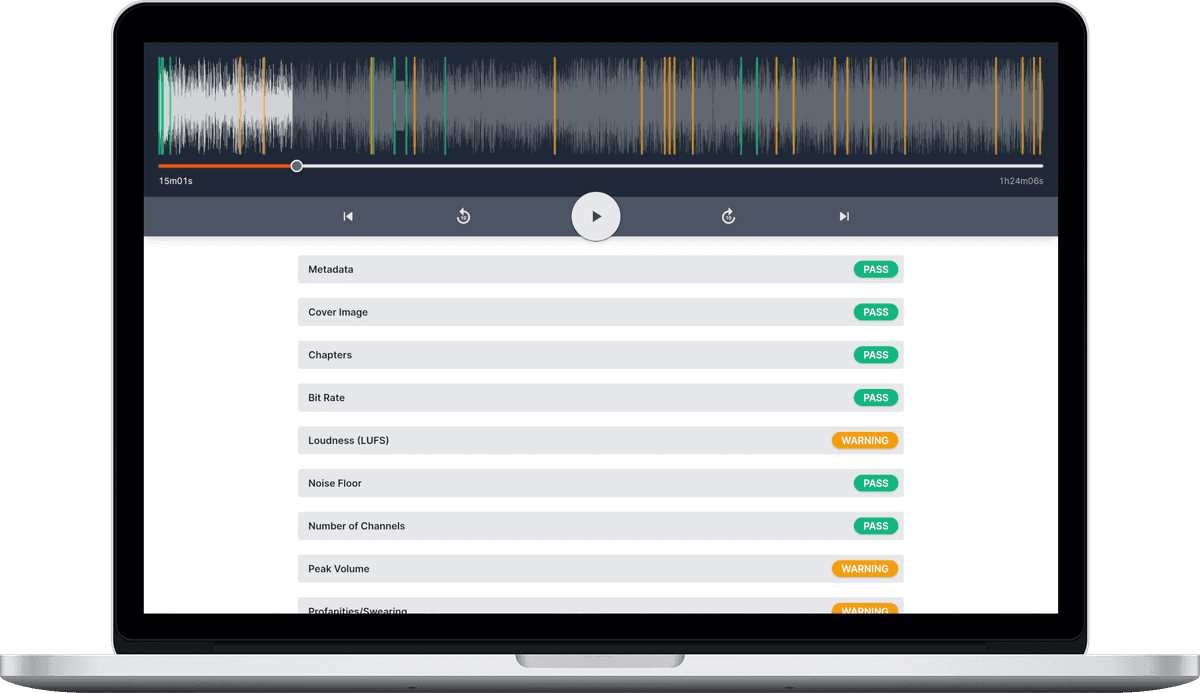
GarageBand is the most-installed audio software on Earth that nobody chose: it comes free on every Mac, iPhone and iPad, and for two decades it’s been the first editor a new podcaster on a Mac opens, because it’s already there. Apple calls it “the easiest way to create a great-sounding song on your Mac”, and the word to notice is song — GarageBand is a music app that podcasters borrow, not a podcast tool. Audio Audit is the other way around entirely: a podcast checker that reads your finished episode, measures whether it’s fit to publish, fixes the specific things that aren’t, and keeps watching your feed afterwards.
There’s less overlap on this page than on any other comparison we’ve written, and that’s the point of writing it. GarageBand will record you, cut your tape and mix your music bed. What it will not do is tell you a single number about the result — and as of August 2026, Audio Audit both measures those numbers and fixes them, with Enhancements for noise reduction, speech levelling, loudness normalisation and clean metadata. Analyse, fix, verify.
The short version: GarageBand gets a beginner from nothing to a recorded episode; Audio Audit tells you whether that episode is actually ready.
This page was last fact-checked against apple.com in September 2026.
Comparison Overview
File and Metadata Checks
| Feature | GarageBand | Audio Audit | | ------- | --------— | ----------- | | Metadata checking | ❌ No, it writes just three tags on export: artist, composer, album | ✅ Yes | | Cover art checking | ❌ No — episode artwork left with the old Podcast track in 2013 | ✅ Yes | | Chapter checking | ❌ No, markers don’t export as podcast chapters | ✅ Yes | | Bit-rate checking | ❌ No, you pick from four export presets and hope | ✅ Yes | | Sample-rate checking | ❌ No | ✅ Yes | | Sample-width checking | ❌ No | ✅ Yes | | Channel count checking (stereo/mono) | ❌ No | ✅ Yes |
Analysis and Detection
| Feature | GarageBand | Audio Audit | | ------- | --------— | ----------- | | LUFS/loudness checking | ❌ No — there is no loudness meter of any kind | ✅ Yes | | Peak volume checking | ❌ No, clip lights only, with no numeric readout | ✅ Yes | | Noise floor checking | ❌ No | ✅ Yes | | Unwanted noise detection (coughs, knocks, pets, etc.) | ❌ No | ✅ Yes, dozens of noise types | | Filler word detection (uhm, ahh, etc.) | ❌ No | ✅ Yes | | Long silence detection | ❌ No | ✅ Yes | | Restarted sentence detection | ❌ No | ✅ Yes | | Swearing detection | ❌ No | ✅ Yes | | Automatic transcriptions | ❌ No | ✅ Yes |
Enhancement and Editing
| Feature | GarageBand | Audio Audit | | ------- | --------— | ----------- | | Audio file modification | ✅ Yes, it’s an editor | ✅ Yes (Enhancements) | | One-pass enhancement of a finished episode | ❌ No | ✅ Yes — measured processing, no generative AI | | Noise reduction | ❌ No, a simple noise gate is the only tool | ✅ Yes, profile measured from your recording | | Speech levelling (compression) | ✅ Yes, compressor and EQ presets like Narration Vocal | ✅ Yes | | Loudness normalisation (LUFS targets) | ❌ No — “Auto Normalize” pushes peaks to 0 dBFS, which is a different thing | ✅ Yes, presets for podcasts, YouTube and ACX | | Metadata & cover art writing | ❌ No artwork, no chapters — three text tags only | ✅ Yes, without re-encoding audio | | Automatic filler word removal | ❌ No | ❌ No | | Automatic silence removal | ❌ No | ❌ No | | Transcript-based editing | ❌ No | ❌ No |
Monitoring and Reporting
| Feature | GarageBand | Audio Audit | | ------- | --------— | ----------- | | Automatic reports by email | ❌ No | ✅ Yes | | RSS feed monitoring | ❌ No | ✅ Yes | | Scoring over the long-term across shows and team members | ❌ No | ✅ Yes |
Plans and Pricing
| Feature | GarageBand | Audio Audit | | ------- | --------— | ----------- | | Free trial | ✅ Not needed — it’s free with your Apple device | ✅ Yes | | Free tier | ✅ Yes, the whole app | ✅ Yes, free credits every month | | Pricing model | Free (Apple’s paid path is Logic Pro at $199.99) | Pay-as-you-go credits or subscription — see /pricing | | One-off credit top-ups (no subscription needed) | — | ✅ Yes — credit packs valid 12 months |
What GarageBand Is Actually For
Credit first: as a free on-ramp, GarageBand is hard to argue with. It records real multitrack audio — up to 255 tracks on a Mac, 32 on an iPhone or iPad — the compressor and EQ presets like Narration Vocal are genuinely sensible starting points for speech, and recording a decent episode on the phone already in your pocket is something no other free tool on this shelf does as smoothly. For an absolute beginner, “it’s already installed” is a real feature.
But it’s worth knowing that GarageBand used to be more of a podcast tool than it is now. The old Podcast track — chapter markers, episode artwork, the works — was removed in the 2013 rewrite and has never come back. What’s left is a music app: the tuning tools are for singers, the loops are for beats, and the export dialog’s idea of metadata is three text fields. Apple’s energy visibly goes elsewhere — recent GarageBand updates have been icon refreshes and bug fixes, while the AI features land in Logic Pro, the $199.99 upgrade Apple itself points serious users toward.
Audio Audit doesn’t record or edit anything, and we have no plans to bluff at it. We detect — filler words, long silences, restarted sentences, coughs and car alarms, each with a timestamp — and you cut them in your editor. GarageBand included.
Loudness: No Meter, No Number, No Target
The standard loudness for podcasts is -16 LUFS, and our customers tell us it’s the number one thing they check their reports for.
GarageBand cannot tell you that number, and it can’t hit it either. There is no loudness meter anywhere in the app — the channel meters show level and turn red at clipping, and that’s the entire measurement story. The one automatic control, on by default, is what Apple’s manual calls exporting “at the highest volume level (0 dBFS) at which no distortion occurs” — peak normalisation. Peaks and loudness are different things: pushing your peaks to 0 dBFS can leave a quiet, uncompressed voice recording miles below -16 LUFS while a heavily produced episode lands miles above it. Two GarageBand exports with identical settings can differ in perceived loudness enormously, and nothing in the app will ever mention it.
Audio Audit measures instead of guessing. The report gives you the integrated loudness of the finished file on the same ITU-R BS.1770 model broadcast uses, next to the true peak and the noise floor. And the enhancement fixes it: volume normalisation with presets for podcast platforms (-16 LUFS), YouTube (-14 LUFS) and ACX audiobooks (-19 LUFS), all with true-peak-safe limiting — one constant gain change that alters how loud your episode is and never how it breathes. Re-run the report, and the number that GarageBand couldn’t show you is there in writing.
After Export: Three Tags and No Artwork
A GarageBand export carries artist, composer and album — and nothing else. No episode artwork, no chapters, no year, no genre, no comment field, and a bitrate chosen from four fixed presets. Every piece of that is something a podcast directory or app cares about, and every piece of it is invisible from inside GarageBand.
That’s the audit’s home ground. Audio Audit reads the exported file and checks everything a directory and a listener will meet: bit rate, sample rate, sample width, channel count, peak, noise floor, loudness, swearing, filler words, long silences, restarted sentences, metadata and cover art. Where a check fails, the fix comes pre-ticked — and if tags and artwork are all you change, the audio isn’t re-encoded at all. Then point the feed monitor at your show and it re-checks the file your host actually serves, every episode, with reports by email and scores that build over time. Hosts re-encode; the monitor is how you find out what that did to your loudness and peaks.
Paying For It
Both halves of this page are kind to a zero budget. GarageBand is entirely free with your Apple hardware, and nobody should pay for an editor while it does the job. Audio Audit gives you free credits every month, with credit top-up packs (valid 12 months) and monthly plans only when your volume needs them — current prices on the pricing page. An occasional show can genuinely run this whole workflow for nothing.
So Which One?
Both — they don’t compete for a single minute of your workflow. Record and cut your episode in GarageBand, because it’s free and it’s already on your Mac or iPhone. Then run the export through Audio Audit before you publish: it will tell you the loudness GarageBand has no meter for, normalise it to -16 LUFS, write the artwork and tags GarageBand can’t, and flag the coughs and ums you stopped hearing three edits ago. When your show outgrows GarageBand, the audit doesn’t change — it works the same on files from Logic, Audacity or anything else you graduate to.
Want the full detail on what Audio Audit’s enhancements do? See the Enhancements announcement and the Enhancing Audio guide, or head to the Pricing page to see what a report or an enhancement costs for your episode length. Comparing other tools too? We’ve written the same honest breakdown for Audacity, Alitu, Auphonic, Descript, Adobe Podcast Enhance and Cleanvoice.
Photos courtesy of Ruben Hanssen