Audacity vs. Audio Audit (comparison)
 Damian Moore, Last updated: 16 October 2026
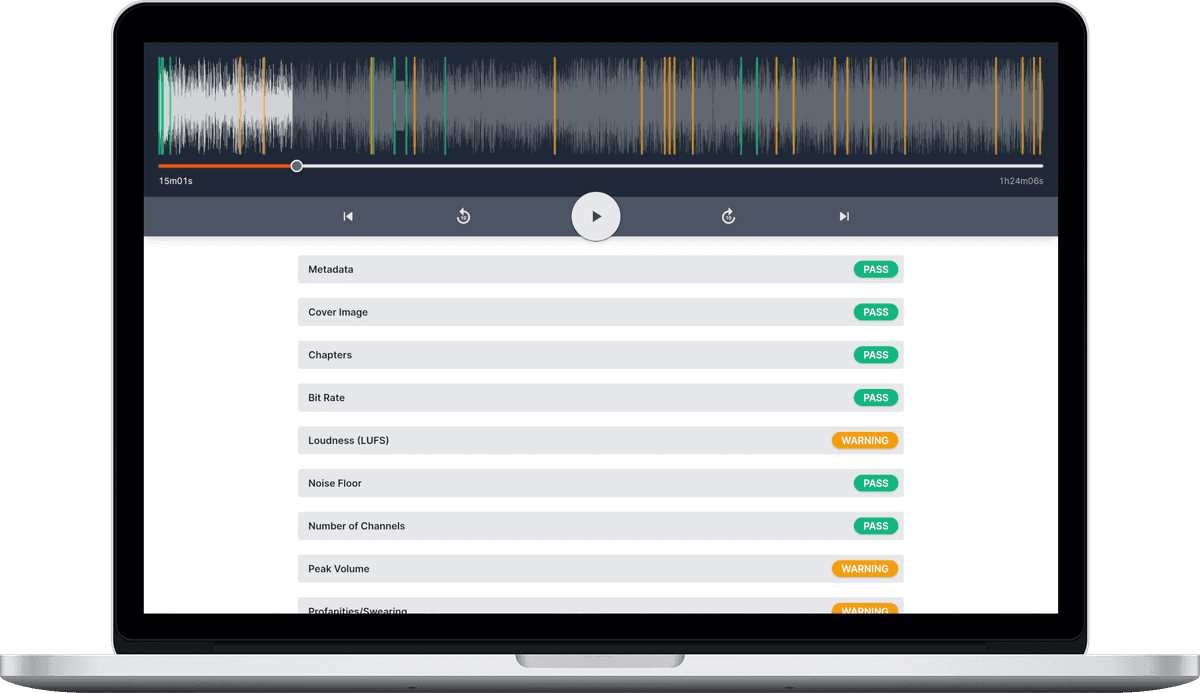
Audacity is the most popular audio editor podcasters have ever had — in The Podcast Host’s gear survey, roughly one in four podcasters edit with it, which is more than any paid tool can claim. It’s a free, open-source, multitrack editor for Windows, Mac and Linux, it has been the default answer to “how do I edit my podcast without spending money?” for two decades, and its maker’s promise is worth quoting: Audacity “has always been and will always remain free for everyone”. Audio Audit is a different kind of tool entirely: it doesn’t edit anything. It reads the finished episode, measures whether it’s actually fit to publish, fixes the specific things that aren’t, and keeps checking your feed after you’ve moved on.
Where they overlap is at the end of the edit. Audacity has a LUFS-based Loudness Normalization effect and a well-worn Noise Reduction effect, so a careful Audacity user can get most of the way to a compliant episode by hand. What Audacity never does is show you the result: there’s no loudness meter, no report, and no check of the file you exported. Audio Audit, as of August 2026, works from the other side — with Enhancements it applies noise reduction, speech levelling, loudness normalisation and clean metadata, and then you re-run the report to prove the numbers actually moved.
Audacity gives you the workshop and leaves the measuring to you; Audio Audit does the measuring for you.
This page was last fact-checked against audacityteam.org in September 2026.
Comparison Overview
File and Metadata Checks
| Feature | Audacity | Audio Audit |
|---|---|---|
| Metadata checking | ❌ No, though a Metadata Tags Editor writes basic ID3 tags on export | ✅ Yes |
| Cover art checking | ❌ No — embedded artwork is stripped on export | ✅ Yes |
| Chapter checking | ❌ No, though label tracks can export a chapters file | ✅ Yes |
| Bit-rate checking | ❌ No | ✅ Yes |
| Sample-rate checking | ❌ No, shown per track in the editor rather than checked | ✅ Yes |
| Sample-width checking | ❌ No, the display reflects your import preferences, not the file | ✅ Yes |
| Channel count checking (stereo/mono) | ❌ No, visible per track rather than checked | ✅ Yes |
Analysis and Detection
| Feature | Audacity | Audio Audit |
|---|---|---|
| LUFS/loudness checking | ❌ No, there is no loudness meter — normalisation applies a target without reporting a figure | ✅ Yes |
| Peak volume checking | ❌ No, though the editor has live peak meters and Find Clipping | ✅ Yes |
| Noise floor checking | ❌ No, though the third-party ACX Check plugin measures it for audiobooks | ✅ Yes |
| Unwanted noise detection (coughs, knocks, pets, etc.) | ❌ No, Click Removal works on selections you find yourself | ✅ Yes, dozens of noise types |
| Filler word detection (uhm, ahh, etc.) | ❌ No | ❌ No |
| Long silence detection | ❌ No, Truncate Silence cuts silences rather than flagging them | ✅ Yes |
| Restarted sentence detection | ❌ No | ✅ Yes |
| Swearing detection | ❌ No | ✅ Yes |
| Automatic transcriptions | ❌ No, though Intel’s free OpenVINO plugin adds offline Whisper transcription | ✅ Yes |
Enhancement and Editing
| Feature | Audacity | Audio Audit |
|---|---|---|
| Audio file modification | ✅ Yes | ✅ Yes (Enhancements) |
| One-pass enhancement of a finished episode | ❌ No, effects are applied one at a time by hand | ✅ Yes — measured processing, no generative AI |
| Noise reduction | ✅ Yes, two-step: capture a noise profile, then apply | ✅ Yes, profile measured from your recording |
| Speech levelling (compression) | ✅ Yes, separate Compressor and Limiter effects | ✅ Yes |
| Loudness normalisation (LUFS targets) | ✅ Yes, any target you type in (the default is broadcast’s -23 LUFS) | ✅ Yes, presets for podcasts, YouTube and ACX |
| Metadata & cover art writing | ✅ Yes for basic ID3 text tags — but cover art can’t be added and existing art is removed | ✅ Yes, without re-encoding audio |
| Automatic filler word removal | ❌ No | ❌ No |
| Automatic silence removal | ✅ Yes, via Truncate Silence | ❌ No |
| Transcript-based editing | ❌ No | ❌ No |
Monitoring and Reporting
| Feature | Audacity | Audio Audit |
|---|---|---|
| Automatic reports by email | ❌ No | ✅ Yes |
| RSS feed monitoring | ❌ No | ✅ Yes |
| Scoring over the long-term across shows and team members | ❌ No | ✅ Yes |
Plans and Pricing
| Feature | Audacity | Audio Audit |
|---|---|---|
| Free trial | ✅ Not needed — the whole program is free | ✅ Yes |
| Free tier | ✅ Yes, everything, forever | ✅ Yes, free credits every month |
| Pricing model | Free and open source (GPL) | Pay-as-you-go credits or subscription — see /pricing |
| One-off credit top-ups (no subscription needed) | — | ✅ Yes — credit packs valid 12 months |
Editing: Free, Capable, and Entirely Manual
Let’s give Audacity its due first, because a quarter of the podcasting world can’t be wrong about what it’s for. It records, it edits multitrack, it cuts, fades, and mixes, and every last bit of it costs nothing — no trial clock, no feature gates, no premium tier waiting behind the tenth export. Muse Group, its steward since 2021, has kept the promise that there will be no artificial limitations, and in an industry where “free” usually means “free-shaped”, that’s worth respect.
The toolbox is deep, too. Noise Reduction is the classic two-step: select a second of room tone, capture a noise profile, then apply the reduction across the episode — the same measured, subtractive approach we believe in ourselves. Truncate Silence will shorten the dead air in a whole episode in one pass, with control over how much silence survives. And Audacity deserves particular credit for something most free tools get wrong: it correctly separates Normalize (which aims peaks at a dBFS ceiling) from Loudness Normalization (which targets perceived loudness in LUFS). Its own manual is clearer on that distinction than plenty of paid products manage.
There are real catches, and Audacity’s own forum is candid about them. Everything is manual: there’s no one-pass clean-up, no filler-word detection, no transcript to edit — you find the ums with your ears and cut them with your hands. And the workflow has enough long-standing quirks that the developers themselves describe the current rewrite as stripping out “confusing modes” and “this-is-not-allowed restrictions”. It’s a workshop, not a valet.
Audio Audit doesn’t compete with any of this, and we have no plans to bluff at it. There is no editor, no timeline, no mixer. We detect long silences, restarted sentences and stray noises, and mark them with timestamps so you know how much of a problem you have and where it is — but you cut them somewhere else. In Audacity, quite possibly.
Loudness: A Target You Can Set, a Number You Never See
The standard loudness for podcasts is -16 LUFS, and our customers tell us it’s the number one thing they check their reports for.
Audacity can hit that number. Its Loudness Normalization effect measures perceived loudness properly and applies gain to reach whatever target you type in. But notice the two traps. First, the default target is -23 LUFS — the EBU broadcast standard, which is the right answer for television and seven decibels too quiet for a podcast. Type -16 yourself, every time, or your episode leaves the workshop sounding noticeably quieter than every show around it. Second, and stranger for an audio program of this pedigree: Audacity has no loudness meter. Not on the toolbar, not in the analyzers, nowhere — and before you point at Audacity 4’s new track-header meters, those read level in dBFS, which is a different measurement answering a different question. You can apply a LUFS target but you can never read one — the forum’s standing advice is to go and install a third-party VST meter. The closest built-in relative is the community’s ACX Check plugin, which measures RMS and noise floor against audiobook rules, not BS.1770 loudness against podcast ones.
So an Audacity episode’s loudness is a thing you did, not a thing you know. Audio Audit’s whole posture is the reverse: measure first. Volume normalisation ships with presets for podcast platforms (-16 LUFS), YouTube (-14 LUFS) and ACX audiobooks (-19 LUFS), all with true-peak-safe limiting and a custom option if your target is something else. It’s a two-pass measurement built on the same ITU-R BS.1770 loudness model broadcast uses: measure the whole episode, then apply a single constant gain change, so normalisation changes how loud your episode is and never how it breathes. And when it’s done, you re-run the report and the integrated loudness lands next to the true peak, in writing — the number Audacity never shows you.
What Audacity Does to Your Files on Export
This section is about what Audacity takes away from your files, and it surprises people.
Audacity’s Metadata Tags Editor writes the basic ID3 text tags on export: title, artist, album, year, genre, comments. Useful, as far as it goes. But it has no field for cover art at all, and it doesn’t pass existing art through either: export an MP3 that came in with embedded artwork and the artwork is gone. Audacity’s own forum says so: embedded covers aren’t supported, and existing art is discarded. There’s also a long-open issue where batch exports stamp the first file’s metadata onto every file in the run, which is exactly the kind of mistake nobody notices until a listener does. Chapters fare a little better — label tracks can be exported as a chapters file — but nothing checks any of it.
Audio Audit treats the exported file as the thing that matters, because it’s the thing your listeners get. The report reads what’s actually there: bit rate, sample rate, sample width, channel count, peak level, noise floor, loudness, swearing, restarted sentences, long silences, missing metadata, and cover art that podcast directories will reject — including the art your editor dropped on export without telling you. Where a check fails, the enhancement that would fix it comes pre-ticked on the report, and if metadata and artwork are the only things you change, the audio isn’t re-encoded at all.
Then it keeps going after you publish. Point Audio Audit at your RSS feed and it re-checks the file your host actually served, which isn’t always the file you uploaded — hosts re-encode, and a re-encode can shift your loudness and clip your peaks long after every tool in your production chain has finished and gone home. Reports arrive by email, scores build up across episodes, shows and team members, and the trend tells you whether your audio is slowly getting worse. Audacity’s job ends at export; ours is only half done at that point.
Audacity 4 Is Here
Timing has a sense of humour: Audacity 4.0.0 was released on 3 September 2026, the day before this page went up. If you’re choosing tools now, this is the big one. The interface has been rebuilt from the ground up on Qt6, replacing the wxWidgets toolkit Audacity had worn for two decades, and it shows: native high-DPI rendering, proper themes including a dark one, panels you can float, dock or hide, and layouts you can save as Workspaces and switch between. The editing model changed too — clips are now first-class things you select, group and move between tracks, splitting has its own dedicated tool, you can record anywhere on the timeline, and the spectrogram has been redesigned and renders considerably faster. Projects save to a new .aup4 format; your existing .aup3 files still open and convert on the way in.
Be aware of what a rewrite costs, because Audacity is unusually straight about it. Version 4.0 ships without a list of things 3.x users lean on: Time Tracks, Note/MIDI tracks, the Mixer, the Macro Manager and the scripting pipe, VAMP and LADSPA plugin hosting, and Play-at-Speed. The release notes say plainly that Audacity 4 “ships with some missing exporting and rendering features, analyzers, and effects”, with the team working to restore them in later releases. Supported plugin formats are now VST3, Nyquist, LV2 on Linux and Audio Units on macOS — so VST2 hosting has gone as well. None of that is a scandal; it’s what an honest rewrite looks like from the outside. But if your workflow leans on batch macros or one particular old plugin, 3.7.9 is still available, still maintained, and still the safer choice this month.
Two things matter for podcasters in particular. Noise Reduction survived the move — it’s on Audacity’s own 4.0 feature pages, with the same two-step noise-profile method described above. Loudness Normalization is the one to check before you commit to 4.0 for a real episode: at the time of writing its documentation still sits in the Audacity 3 section of the support site with no 4.0 page yet, and the release notes neither list it among the removals nor confirm it made the jump. Open Effect → Volume and compression and see for yourself before you rely on it.
And the thing this page is actually about hasn’t moved. Audacity 4 adds live playback and recording meters in the track headers, which is a genuine improvement — but as above, those are level meters, not loudness meters. There’s still no LUFS readout, still no check of the file you exported, and still no report. Measuring the exported file is a different job from editing it, and that’s the job Audio Audit does.
One bright spot deserves a mention: Intel’s free OpenVINO plugin pack gives Audacity offline AI — Whisper transcription, noise suppression and music separation — running entirely on your own machine, no cloud, no account, no fee. It’s Windows-first and it outputs a label track rather than an editable transcript, but as free AI goes, local-and-private is the right way round. One caveat now that 4.0 has landed: the pack was built for the 3.x line, so check it still loads before you count on it under Audacity 4.
Paying For It
There’s no contest to referee here, so let’s not stage one. Audacity is free. Completely, permanently, for everything it does, under an open-source licence that guarantees it stays that way. Nobody should pay for an editor before trying it, and no comparison page written by a paid product should pretend otherwise.
What you can’t buy from Audacity at any price is the part after the edit: the measurement, the verification and the watching. That’s the part we sell. Audio Audit runs on credits, with free credits every month, monthly plans if your usage is steady, and one-off top-up packs valid for 12 months if it isn’t. Reports and enhancements draw on the same balance — a full clean-up costs about the same per minute as a full standard analysis — and you see the estimate before you commit. Current prices live on the pricing page rather than in this article, because comparison pages go stale and pricing pages don’t. And the free monthly credits mean the Audacity philosophy extends further than you might expect: an occasional show can get its episodes checked without paying us anything either.
So Which One?
If you edit your own podcast and your budget is zero, use Audacity. A quarter of podcasters already do, the toolbox is real, and nothing about it will ambush you with a bill. Learn Loudness Normalization, set it to -16 LUFS yourself, and capture a noise profile before you reach for Noise Reduction — the manual way works, it’s just on you to do it.
If you want to know whether the finished file is actually up to standard, with the measurements to back it up — the loudness figure Audacity never displays, the cover art it silently removed, the metadata a directory will trip over — and then keep an eye on every episode you publish from here on, that’s Audio Audit.
And the two chain together about as naturally as any pair on this site. Edit in Audacity, export your MP3, and run the file through Audio Audit before you publish: the report will tell you what your edit actually produced, restore the artwork and tags Audacity dropped, and normalise the loudness to a target you chose rather than one you remembered to type. Then point the feed monitor at your show and let it check what your listeners are really being served, every episode, from now on.
Want the full detail on what Audio Audit’s enhancements do? See the Enhancements announcement and the Enhancing Audio guide, or head to the Pricing page to see what a report or an enhancement costs for your episode length. Comparing other tools too? We’ve written the same honest breakdown for Alitu, Auphonic, Descript, Adobe Podcast Enhance and Cleanvoice.
Photos courtesy of Jakob Owens