Buzzsprout Magic Mastering vs. Audio Audit (comparison)
 Damian Moore, Last updated: 6 September 2026
This comparison opens a new lane for this series: the podcast host that processes your audio for you. Buzzsprout is one of the most popular hosting platforms in podcasting — over 115,000 podcasters, by its own count — and Magic Mastering is its in-house audio polish: switch it on, pay a small add-on fee, and every episode you upload is levelled, loudness-targeted, de-noised and, since mid-2025, stripped of its “ah”s and “uhm”s, automatically, before your listeners ever hear it. Buzzsprout’s own description is the most honest one-liner in this market: “Magic Mastering is like an Instagram filter for your audio.”
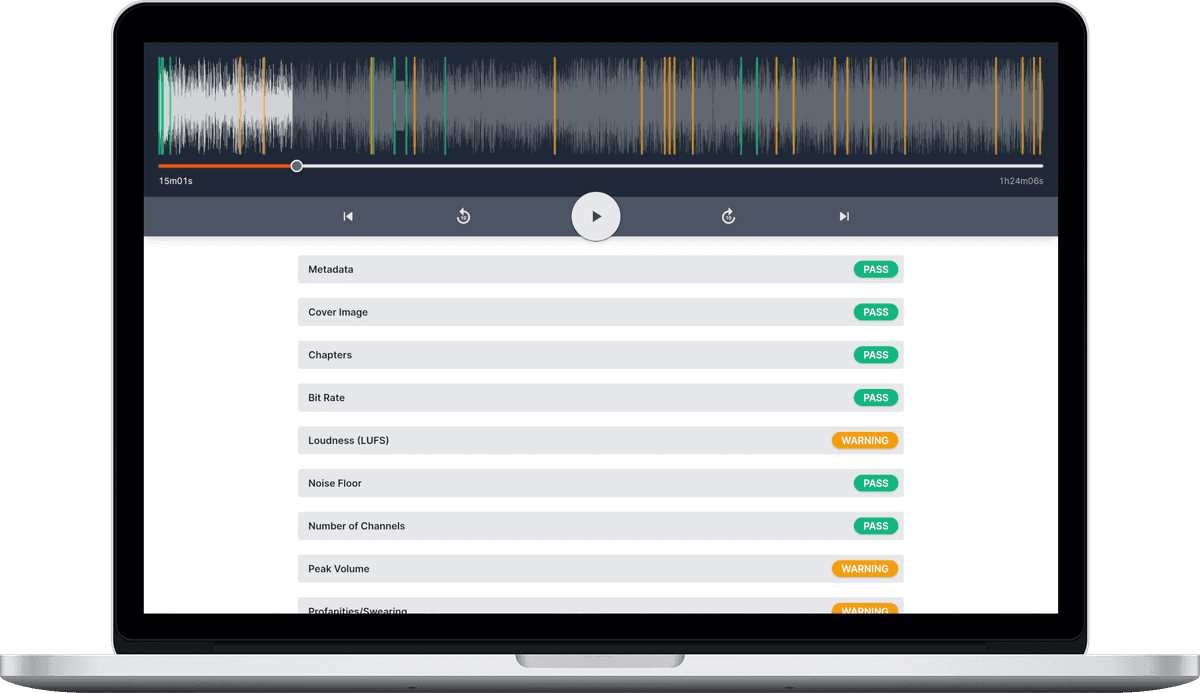
Audio Audit is the opposite instrument. It measures. It reads a finished episode — or the episode your host is actually serving — and reports the loudness, the true peak, the noise floor, the metadata, the artwork and the content problems, with timestamps. As of August 2026 it fixes things too: with Enhancements, it applies noise reduction, speech levelling, loudness normalisation and clean metadata, and then you re-run the report to prove the numbers actually moved. Analyse, fix, verify.
The short version: Magic Mastering polishes your episode on the way in and never shows you a number; Audio Audit’s whole job is the numbers — including the ones your host’s processing changed.
This page was last fact-checked against buzzsprout.com in September 2026.
Comparison Overview
File and Metadata Checks
| Feature | Buzzsprout Magic Mastering | Audio Audit | | ------- | ------------------------— | ----------- | | Metadata checking | ❌ No, tags are written for you rather than checked | ✅ Yes | | Cover art checking | ❌ No, any size is accepted — 1400px+ is only recommended | ✅ Yes | | Chapter checking | ❌ No, though Buzzsprout has chapter editors and Podcasting 2.0 support | ✅ Yes | | Bit-rate checking | ❌ No, everything is re-encoded to the house format | ✅ Yes | | Sample-rate checking | ❌ No | ✅ Yes | | Sample-width checking | ❌ No | ✅ Yes | | Channel count checking (stereo/mono) | ❌ No, uploads are converted to mono unless you pay for the stereo setting | ✅ Yes |
Analysis and Detection
| Feature | Buzzsprout Magic Mastering | Audio Audit | | ------- | ------------------------— | ----------- | | LUFS/loudness checking | ❌ No, it masters to a target without ever reporting the figure | ✅ Yes | | Peak volume checking | ❌ No | ✅ Yes | | Noise floor checking | ❌ No | ✅ Yes | | Unwanted noise detection (coughs, knocks, pets, etc.) | ❌ No, background noise is reduced rather than flagged | ✅ Yes, dozens of noise types | | Filler word detection (uhm, ahh, etc.) | ✅ Yes (Filler Killer) — though it removes them without showing you a list | ✅ Yes | | Long silence detection | ❌ No | ✅ Yes | | Restarted sentence detection | ❌ No | ✅ Yes | | Swearing detection | ❌ No, the explicit flag is a checkbox you tick yourself | ✅ Yes | | Automatic transcriptions | ✅ Yes, free on paid plans (English, Spanish, French) | ✅ Yes |
Enhancement and Editing
| Feature | Buzzsprout Magic Mastering | Audio Audit | | ------- | ------------------------— | ----------- | | Audio file modification | ✅ Yes, automatically on upload | ✅ Yes (Enhancements) | | One-pass enhancement of a finished episode | ✅ Yes — it is the upload | ✅ Yes — measured processing, no generative AI | | Noise reduction | ✅ Yes — Audio Sweetening, plus Power Clean for rough recordings | ✅ Yes, profile measured from your recording | | Speech levelling (compression) | ✅ Yes, Smart Adaptive Leveling between speakers and music | ✅ Yes | | Loudness normalisation (LUFS targets) | ✅ Yes, fixed targets: -19 LUFS mono / -16 LUFS stereo at -1 dBTP | ✅ Yes, presets for podcasts, YouTube and ACX | | Metadata & cover art writing | ✅ Yes, ID3 tags and artwork written on every upload | ✅ Yes, without re-encoding audio | | Automatic filler word removal | ✅ Yes (Filler Killer), silently | ❌ No | | Automatic silence removal | ❌ No | ❌ No | | Transcript-based editing | ❌ No, the transcript editor edits text, not audio | ❌ No |
Monitoring and Reporting
| Feature | Buzzsprout Magic Mastering | Audio Audit | | ------- | ------------------------— | ----------- | | Automatic reports by email | ❌ No | ✅ Yes | | RSS feed monitoring | ❌ No — it serves your feed rather than checking it | ✅ Yes | | Scoring over the long-term across shows and team members | ❌ No, statistics count downloads, not audio quality | ✅ Yes |
Plans and Pricing
| Feature | Buzzsprout Magic Mastering | Audio Audit | | ------- | ------------------------— | ----------- | | Free trial | ✅ Yes — a free hosting plan, and Magic Mastering free on one episode | ✅ Yes | | Free tier | ✅ Yes, 2 upload hours a month, episodes hosted for 90 days | ✅ Yes, free credits every month | | Pricing model | Hosting subscription plus a Magic Mastering add-on fee that scales with your plan | Pay-as-you-go credits or subscription — see /pricing | | One-off credit top-ups (no subscription needed) | ❌ No | ✅ Yes — credit packs valid 12 months |
Set It and Forget It: What Magic Mastering Gets Right
Let’s be fair first, because Magic Mastering is better-founded than most one-click audio magic. Buzzsprout doesn’t pretend to have invented the processing: its own FAQ says plainly that it “has licensed the Auphonic algorithms to power much of what you are getting with Magic Mastering” — the same Auphonic we’ve compared directly, and one of the most respected automated processors in podcasting. On top of that engine sit Smart Adaptive Leveling for the loud-host-quiet-guest problem, Audio Sweetening for hum and hiss, and Power Clean for genuinely rough recordings.
The targets are right, too, and worth spelling out because this is the rare tool that handles the mono/stereo distinction properly: -19 LUFS for mono episodes, -16 LUFS for stereo, both with a -1 dB true-peak ceiling — exactly the arithmetic Apple’s own audio guidance implies, applied correctly in both channel layouts. And Filler Killer, added in July 2025, “cautiously detects and removes filler words like ‘ah’ and ‘uhm’”; in one independent test on an hour-long episode it removed over three and a half minutes of filler without an audible seam.
For the podcaster Buzzsprout is built for, the pitch is coherent: upload the file, and everything after that is handled. Buzzsprout’s FAQ even says the quiet part warmly — asked what LUFS means, it answers: “Not sure what that means? You don’t have to! That’s why we built Magic Mastering!” For a lot of people, that’s exactly the product they want. This page is about what that convenience costs you in knowledge.
The Number Your Host Never Shows You
The standard loudness for podcasts is -16 LUFS, and our customers tell us it’s the number one thing they check their reports for.
Here’s the thing about Buzzsprout that applies whether you buy Magic Mastering or not: your host processes every episode. Uploads are converted to MP3 at 96 kbps mono as standard — Buzzsprout calls it industry best practice for spoken word, and for many shows it is — unless the file is already smaller, or you pay for the 192 kbps stereo setting. Add Magic Mastering and the loudness, levelling and filler processing happen in the same in-between space. The file your listeners download is not the file you exported, by design.
And at no point in any of it does Buzzsprout show you a measurement. No LUFS figure before, no LUFS figure after, no true peak, no bit-rate confirmation on screen. You are asked to trust that the targets were hit — the FAQ’s cheerful “you don’t have to know” is the whole interface. Nor can you run Magic Mastering over your back catalogue to bring old episodes up to the same standard: it only applies at upload time, so a feed can carry two different sounds forever.
This is the strongest case for feed monitoring anywhere in this series, because with a processing host, checking the served file isn’t paranoia — it’s the only way to see your episode at all. Point Audio Audit at your Buzzsprout RSS feed and it downloads what your host actually serves and measures it: integrated loudness against the -16 (or mono -19) target, true peak, noise floor, bit rate, channel count, metadata and artwork, plus the content layer — filler words that survived, long silences, restarted sentences, swearing before the explicit checkbox becomes a directory problem. Reports arrive by email as episodes appear, scores build across episodes, shows and team members, and the trend tells you whether anything in the chain — your recording, your edit, or your host’s processing — is quietly getting worse.
Before the Upload, and What Nobody Checks
Magic Mastering starts when you upload. Everything before that is still on you, and a few things after it are checked by nobody. Buzzsprout will accept cover art at any size — the 1400px minimum and 3000px ideal are recommendations in a help doc, not a gate — so artwork a directory will reject sails straight through. The explicit-content flag is a checkbox you remember to tick, with no detection behind it. And since your channel count, bit rate and sample rate are all decided by the house format, nothing tells you what your file was, or whether the stereo music bed you mixed survived the mono conversion.
Audio Audit covers both ends. Run a report on the file before you upload and you’ll know about the cough at 14:32, the two restarted sentences, the swearing, and the metadata gaps while you can still fix them — with the fixing one click away: where a check fails, the enhancement that would fix it comes pre-ticked, and if metadata is the only thing you change, the audio isn’t re-encoded at all. Then let the feed monitor confirm what came out the other side of your host.
Paying For It
Buzzsprout’s pricing changed recently, so treat this paragraph as a snapshot and buzzsprout.com/pricing as the truth. As of September 2026 the hosting plans run from $15 a month billed annually for an audio podcast (72 upload hours a year), $25 with video distribution, and $30 and up for multiple shows; there’s a free plan with two upload hours a month and episodes hosted for 90 days. Magic Mastering is an add-on priced to your plan tier — $5, $10 or $20 a month — and you can try it free on one episode. Cohost AI, Buzzsprout’s transcription-and-show-notes assistant, is a second add-on at the same prices.
That’s cheap for hands-off mastering, genuinely. A podcaster on the entry plan gets Auphonic-grade processing for $60 a year without learning a single term of art. The trade is that it’s a subscription on top of a subscription, it only touches episodes uploaded from now on, and the one thing it will never sell you is the measurement.
Audio Audit runs on credits, with free credits every month, monthly plans if your usage is steady, and one-off top-up packs valid for 12 months if it isn’t. Reports and enhancements draw on the same balance — a full clean-up costs about the same per minute as a full standard analysis — and you see the estimate before you commit. Current prices live on the pricing page rather than in this article, because comparison pages go stale and pricing pages don’t.
So Which One?
This is the least either/or page on this site, because the two products don’t overlap so much as bracket your host’s black box from both sides.
If you host on Buzzsprout and want your audio handled without ever thinking about it, Magic Mastering is honest value: real Auphonic-derived processing, correct targets, and a filler remover that works. Turn it on and forget it — that’s the product, and it’s a good one.
And then point Audio Audit at the result. Run the pre-upload report to catch what mastering can’t fix — the content, the artwork, the tags — and put the feed monitor on your Buzzsprout RSS so every episode your host serves gets measured against the standard, in writing, forever. Your host processes your audio and never shows you the number. We’re the number.
Want the full detail on what Audio Audit’s enhancements do? See the Enhancements announcement and the Enhancing Audio guide, or head to the Pricing page to see what a report or an enhancement costs for your episode length. Comparing other tools too? We’ve written the same honest breakdown for Auphonic — the engine behind Magic Mastering — as well as Alitu, Descript, Adobe Podcast Enhance and Cleanvoice.
Photos courtesy of onehundredseventyfive