Adobe Audition vs. Audio Audit (comparison)
 Damian Moore, Last updated: 16 October 2026
First, a disambiguation, because Adobe has two audio products podcasters mix up. Adobe Podcast Enhance is the free browser AI filter that rescues bad recordings — we’ve compared it separately. This page is about Adobe Audition: the professional desktop DAW that broadcast and post-production people have trusted for twenty years, and the editor serious podcasters name more than any other when they’ve outgrown the beginner tools.
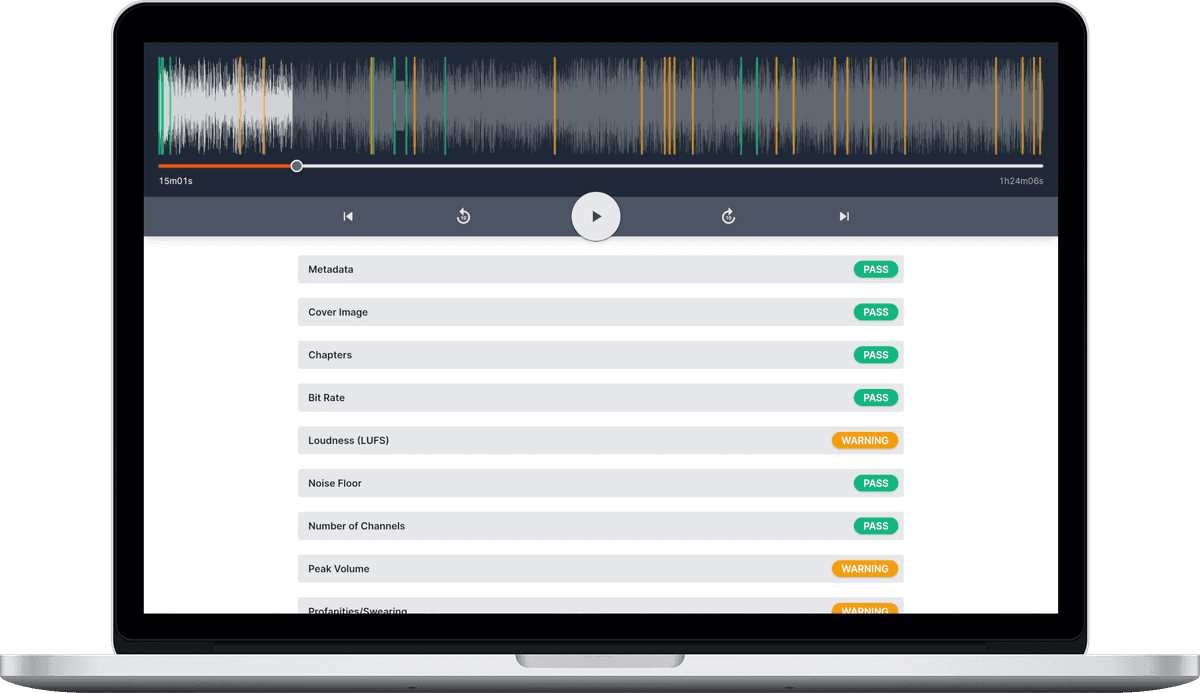
Audition earns a different kind of comparison, because unlike almost everything else on this shelf, it actually measures things. It has broadcast-grade loudness metering built in, an amplitude-statistics scan that reports integrated loudness and true peak, and a diagnostics panel that finds clicks, hum and silences for you. Audio Audit’s job overlaps there and then goes somewhere Audition doesn’t: it reads any finished episode, checks it against everything a podcast directory and a listener care about — content included — fixes what fails, and keeps checking your feed after you publish. As of August 2026 the fixing is built in: with Enhancements, it applies noise reduction, speech levelling, loudness normalisation and clean metadata, then you re-run the report to prove the numbers actually moved.
Audition is a professional’s workbench with real meters on it. Audio Audit is the independent inspection, and it keeps watching your feed after you publish, with no workbench skills required.
This page was last fact-checked against adobe.com and helpx.adobe.com in September 2026.
Comparison Overview
File and Metadata Checks
| Feature | Adobe Audition | Audio Audit |
|---|---|---|
| Metadata checking | ❌ No, though the Metadata panel can view and edit ID3, BWF and XMP tags | ✅ Yes |
| Cover art checking | ❌ No check, though it can embed album art in MP3s | ✅ Yes |
| Chapter checking | ❌ No — markers export as XMP, not the ID3 chapters podcast apps read | ✅ Yes |
| Bit-rate checking | ❌ No, visible in file properties rather than checked | ✅ Yes |
| Sample-rate checking | ❌ No, visible in the editor rather than checked | ✅ Yes |
| Sample-width checking | ❌ No | ✅ Yes |
| Channel count checking (stereo/mono) | ❌ No | ✅ Yes |
Analysis and Detection
| Feature | Adobe Audition | Audio Audit |
|---|---|---|
| LUFS/loudness checking | ✅ Yes — Loudness Radar metering and Amplitude Statistics reports | ✅ Yes |
| Peak volume checking | ✅ Yes, true peak in Amplitude Statistics | ✅ Yes |
| Noise floor checking | ❌ No named metric, though statistics on a silent region get you there by hand | ✅ Yes |
| Unwanted noise detection (coughs, knocks, pets, etc.) | ✅ Yes for technical faults — clicks, pops, hiss, hum — but not coughs, pets or doorbells | ✅ Yes, dozens of noise types |
| Filler word detection (uhm, ahh, etc.) | ❌ No, a “Remove Ahh and Umm” preset pattern-matches at best | ❌ No |
| Long silence detection | ✅ Yes, Diagnostics can find, mark and delete silences | ✅ Yes |
| Restarted sentence detection | ❌ No | ✅ Yes |
| Swearing detection | ❌ No, bleeping is a manual generate-tone job | ✅ Yes |
| Automatic transcriptions | ❌ No — Adobe’s speech-to-text lives in Premiere Pro, not Audition | ✅ Yes |
Enhancement and Editing
| Feature | Adobe Audition | Audio Audit |
|---|---|---|
| Audio file modification | ✅ Yes | ✅ Yes (Enhancements) |
| One-pass enhancement of a finished episode | ❌ No, though Essential Sound presets and Match Loudness batches get close | ✅ Yes — measured processing, no generative AI |
| Noise reduction | ✅ Yes — classic noise-print reduction plus ML DeNoise and DeReverb | ✅ Yes, profile measured from your recording |
| Speech levelling (compression) | ✅ Yes, Speech Volume Leveler and the Essential Sound panel | ✅ Yes |
| Loudness normalisation (LUFS targets) | ✅ Yes — Match Loudness conforms batches to BS.1770 targets and reports the numbers | ✅ Yes, presets for podcasts, YouTube and ACX |
| Metadata & cover art writing | ✅ Yes, ID3 tags and MP3 album art via the Metadata panel | ✅ Yes, without re-encoding audio |
| Automatic filler word removal | ❌ No | ❌ No |
| Automatic silence removal | ✅ Yes, via Diagnostics > Delete Silence | ❌ No |
| Transcript-based editing | ❌ No | ❌ No |
Monitoring and Reporting
| Feature | Adobe Audition | Audio Audit |
|---|---|---|
| Automatic reports by email | ❌ No | ✅ Yes |
| RSS feed monitoring | ❌ No | ✅ Yes |
| Scoring over the long-term across shows and team members | ❌ No | ✅ Yes |
Plans and Pricing
| Feature | Adobe Audition | Audio Audit |
|---|---|---|
| Free trial | ✅ Yes, Adobe’s standard short Creative Cloud trial | ✅ Yes |
| Free tier | ❌ No | ✅ Yes, free credits every month |
| Pricing model | Creative Cloud subscription only — roughly $23/month single-app on an annual plan | Pay-as-you-go credits or subscription — see /pricing |
| One-off credit top-ups (no subscription needed) | ❌ No | ✅ Yes — credit packs valid 12 months |
The Deepest Toolbox Podcasting Ever Borrowed
Audition wasn’t built for podcasts — it was built for broadcast and post — and that heritage is exactly what makes it formidable. The spectral editor lets you see a cough and paint it out. Noise reduction comes in two generations: the classic capture-a-noise-print subtraction, and the newer machine-learning DeNoise and DeReverb, which Adobe describes as offering “industry-leading results without noise prints, complicated knobs and sliders, or long latencies”. The Essential Sound panel wraps the whole restoration chain — loudness auto-match, noise, rumble, hum, de-essing — into a preset a non-engineer can apply. And the Diagnostics panel does something close to an audit: scan a file for clicks, pops, hiss, hum or silence, get a list of everything found, and repair, delete or mark each item.
If you already pay for Creative Cloud and know your way around a DAW, this is about as much editing power as money buys. Audio Audit competes with none of it, and we have no plans to bluff at it. There is no timeline, no spectral brush, no multitrack mixer. We detect — long silences, restarted sentences, and the coughs, doorbells and car alarms that Diagnostics’ click-and-hum scanners aren’t listening for — and mark everything with timestamps for you to fix in an editor. Audition, quite possibly.
Loudness: Audition Shows You the Numbers — If You Know Where to Look
The standard loudness for podcasts is -16 LUFS, and our customers tell us it’s the number one thing they check their reports for.
Credit first, and it’s substantial: Audition is one of the very few editors anywhere that treats loudness measurement as a first-class feature. The Loudness Radar — licensed from the metering specialists at TC Electronic — shows broadcast-grade loudness in real time. Amplitude Statistics scans a file and reports its integrated loudness and true peak. Match Loudness batch-conforms whole folders of files to ITU-R BS.1770 targets, EBU R128 and ATSC A/85 included, and shows you the achieved figures. Nothing on this page’s competitor column is bluffing; a skilled Audition user can answer every loudness question about an episode without leaving the program. Very few tools podcasters actually use can say that — Apple’s Logic Pro has a loudness meter, Reaper has render statistics, and the list mostly ends there.
So the difference is who does the checking, and three things follow from it. First, in Audition you are the audit: the numbers exist if you know which panel to open, what BS.1770 is, and what target to type — knowledge the tool assumes and most podcasters don’t have. Second, the measurements live and die in the session: there’s no report artefact, nothing to file, share with a client, or compare against last month. Third, the audit stops at sound. Nothing in Audition checks that your metadata is complete, that your cover art passes a directory’s rules, that your chapters actually made it into the file — a sore point, since Audition’s markers export as XMP metadata rather than the ID3 chapters podcast apps read, a gap users have been requesting a fix for, for years — or that episode twelve contains a word your family-friendly rating shouldn’t.
Audio Audit packages the whole question. One report on the finished file: integrated loudness against a preset you pick (-16 LUFS for podcasts, -14 for YouTube, -19 for ACX), true peak, noise floor, bit rate, sample rate, sample width, channels, metadata, artwork, chapters, swearing, silences, restarted sentences. Where a check fails, the fix comes pre-ticked — the same measured, non-generative processing philosophy Audition’s engineers would recognise — and if metadata is the only change, the audio isn’t re-encoded at all. No panels to know about, and the report is a document, not a fleeting readout.
Maintenance Mode: Five Releases, No New Tools
Here’s the part a comparison written in 2026 can’t skip. Audition still works, and works well — but Adobe has visibly stopped building it. Version 26.3, released in June 2026, introduced no new editing tools; its one notable change was removing a feature, CD authoring, which a community expert called “a retrograde step”. Look back across the previous five releases — spring 2025 through summer 2026 — and the pattern holds: bug fixes, a light-mode tweak, native Windows ARM support, and nothing else. In the same window, Premiere Pro received generative AI extension, media intelligence and headline investment. Adobe hasn’t said Audition is done, but its longest-serving users say it for them on Adobe’s own forums — “mothballed”, “on life support” — and the open feature requests that matter to podcasters, ID3 chapter export first among them, have sat unanswered for years.
None of this makes Audition a bad tool today. It makes it a finished one. If its current feature set covers you, it may cover you for years. But if you’re choosing where the standards-checking part of your workflow should live, it’s fair to notice that one candidate is an actively developed audit service and the other is a panel inside a program whose roadmap appears to be an empty page.
After the Export
Audition’s involvement ends at the export dialog, and its metadata panel sees you out well by DAW standards — ID3 text tags and MP3 album art included. But nothing checks the result against a directory’s rules, and nothing watches what happens next. Hosts re-encode, and a re-encode can shift your loudness and clip your peaks long after every meter in Audition showed green.
Audio Audit’s job is only half done at publish. Point it at your RSS feed and it re-checks the file your host actually served, episode after episode. Reports arrive by email, scores build across episodes, shows and team members, and the trend tells you whether your audio is slowly getting worse — the kind of longitudinal quality control that broadcast facilities build entire departments for, running unattended on a podcast feed.
Paying For It
Audition is subscription-only, and the subscription is Creative Cloud. As of September 2026 the single-app plan runs at roughly $23 a month on an annual commitment (around $34 month-to-month), with the all-apps bundles in the $55–70 a month range — Adobe’s pricing page renders its numbers dynamically and reshuffles tiers often enough that you should check adobe.com rather than trust any article, this one included. There’s a short trial and no free tier, and no way to buy Audition outright: stop paying and the workbench is gone.
If you already hold Creative Cloud for Premiere or Photoshop, Audition is effectively free capability and this section is moot. If you’d be subscribing for it, $270-plus a year is a serious bill for an editor in maintenance mode. Audio Audit runs on credits, with free credits every month, monthly plans if your usage is steady, and one-off top-up packs valid for 12 months if it isn’t. Reports and enhancements draw on the same balance — a full clean-up costs about the same per minute as a full standard analysis — and you see the estimate before you commit. Current prices live on the pricing page rather than in this article, because comparison pages go stale and pricing pages don’t.
So Which One?
If you’re a professional — or becoming one — and you want the deepest restoration and measurement toolbox a podcaster can operate by hand, Audition remains a superb workbench, especially if Creative Cloud is already on your bill. Learn Amplitude Statistics, learn Match Loudness, and you can do much of an audit’s arithmetic yourself, one file at a time.
If you want the audit done for you — every measurement in one report, the content checks no DAW attempts, the fixes applied and independently verified, and your feed watched from then on — that’s Audio Audit, and it doesn’t ask you to know what a radar meter is.
And for the Audition owners: the chain still makes sense. Master your episode against the Loudness Radar, export with your tags — then run the file through Audio Audit for the independent second opinion and the checks Audition doesn’t run, and point the feed monitor at your show to catch what your host does to the file after your meters stop watching.
Want the full detail on what Audio Audit’s enhancements do? See the Enhancements announcement and the Enhancing Audio guide, or head to the Pricing page to see what a report or an enhancement costs for your episode length. Comparing other tools too? We’ve written the same honest breakdown for Adobe Podcast Enhance — the other Adobe audio tool — as well as Auphonic, Alitu, Descript and Cleanvoice.
Photos courtesy of Rory Hennessey