Logic Pro vs. Audio Audit (comparison)
 Damian Moore, Last updated: 6 September 2026
Logic Pro is where Mac podcasters end up when they get serious — or at least, when they get serious about sound. It’s Apple’s professional DAW: the full mixing and mastering toolchain, a one-time $199.99 price in a world of subscriptions (though since January 2026 there’s a subscription too), and — unusually for this series — a genuine, built-in loudness meter. Nothing about Logic was designed for podcasts; everything about it was designed for music, and that tension is what this page is really about.
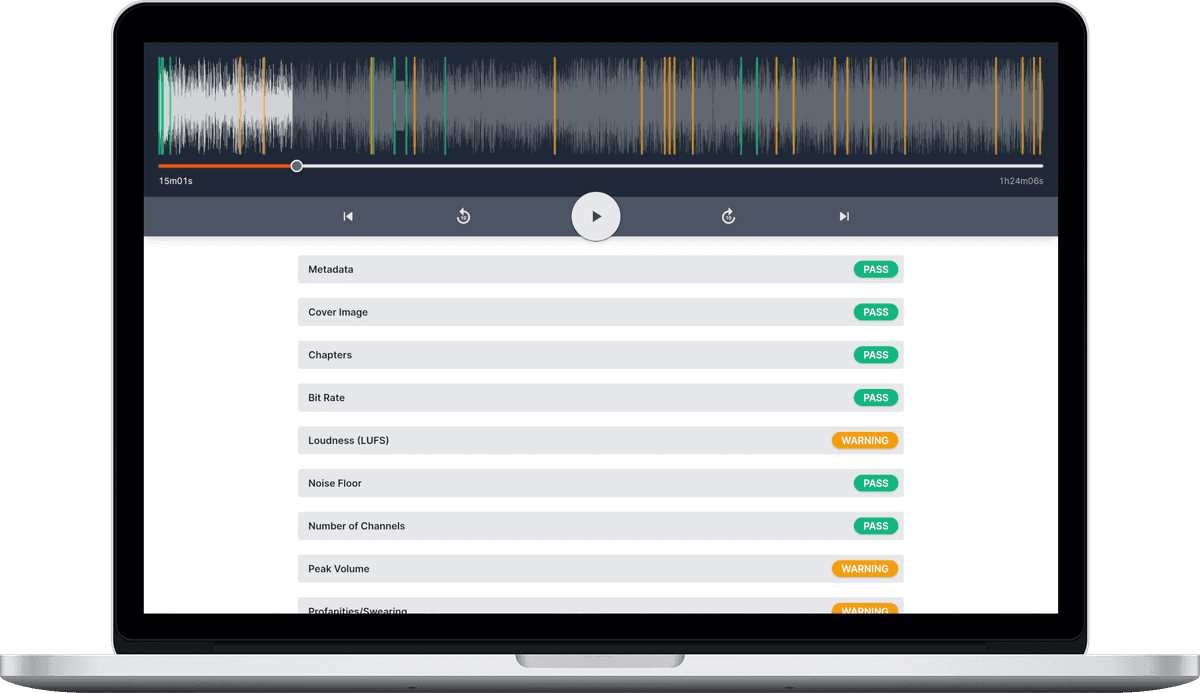
Audio Audit comes from the podcast side of the glass. It reads the finished episode, measures whether it’s fit to publish — loudness against a podcast target, true peak, noise floor, bit rate, metadata, artwork, and the content problems with timestamps — fixes what fails via Enhancements (noise reduction, speech levelling, loudness normalisation, clean metadata), and keeps checking your feed after you publish. Analyse, fix, verify.
The short version: Logic gives a skilled Mac user everything needed to make an episode sound superb; Audio Audit checks the file the episode became — with a podcast’s rules, not a record’s.
This page was last fact-checked against apple.com in September 2026.
Comparison Overview
File and Metadata Checks
| Feature | Logic Pro | Audio Audit |
|---|---|---|
| Metadata checking | ❌ No — it writes ID3 text tags on MP3 bounce, with defaults like Tempo and Initial Key | ✅ Yes |
| Cover art checking | ❌ No, there’s no artwork field at all | ✅ Yes |
| Chapter checking | ❌ No, markers aren’t podcast chapters | ✅ Yes |
| Bit-rate checking | ❌ No, you choose a bounce setting rather than check a file | ✅ Yes |
| Sample-rate checking | ❌ No | ✅ Yes |
| Sample-width checking | ❌ No | ✅ Yes |
| Channel count checking (stereo/mono) | ❌ No | ✅ Yes |
Analysis and Detection
| Feature | Logic Pro | Audio Audit |
|---|---|---|
| LUFS/loudness checking | ✅ Yes — the built-in Loudness Meter shows momentary, short-term and integrated LUFS | ✅ Yes |
| Peak volume checking | ✅ Partially — meters everywhere, but true peak only inside Mastering Assistant | ✅ Yes |
| Noise floor checking | ❌ No | ✅ Yes |
| Unwanted noise detection (coughs, knocks, pets, etc.) | ❌ No | ✅ Yes, dozens of noise types |
| Filler word detection (uhm, ahh, etc.) | ❌ No | ✅ Yes |
| Long silence detection | ❌ No, Remove Silence strips rather than flags | ✅ Yes |
| Restarted sentence detection | ❌ No | ✅ Yes |
| Swearing detection | ❌ No | ✅ Yes |
| Automatic transcriptions | ❌ No | ✅ Yes |
Enhancement and Editing
| Feature | Logic Pro | Audio Audit |
|---|---|---|
| Audio file modification | ✅ Yes | ✅ Yes (Enhancements) |
| One-pass enhancement of a finished episode | ✅ Close — Mastering Assistant is one intelligent pass over your final mix | ✅ Yes — measured processing, no generative AI |
| Noise reduction | ❌ No, a threshold Noise Gate is the only noise tool | ✅ Yes, profile measured from your recording |
| Speech levelling (compression) | ✅ Yes, a full professional dynamics suite | ✅ Yes |
| Loudness normalisation (LUFS targets) | ✅ Partly — Mastering Assistant lands around -14 LUFS with an adjustable knob; the bounce “Normalize” is peak-based | ✅ Yes, presets for podcasts, YouTube and ACX |
| Metadata & cover art writing | ✅ Text tags only on MP3 bounce — no artwork, no chapters | ✅ Yes, without re-encoding audio |
| Automatic filler word removal | ❌ No | ❌ No |
| Automatic silence removal | ✅ Yes, via Remove Silence | ❌ No |
| Transcript-based editing | ❌ No | ❌ No |
Monitoring and Reporting
| Feature | Logic Pro | Audio Audit |
|---|---|---|
| Automatic reports by email | ❌ No | ✅ Yes |
| RSS feed monitoring | ❌ No | ✅ Yes |
| Scoring over the long-term across shows and team members | ❌ No | ✅ Yes |
Plans and Pricing
| Feature | Logic Pro | Audio Audit |
|---|---|---|
| Free trial | ✅ Yes, 30 days via the Apple Creator Studio subscription | ✅ Yes |
| Free tier | ❌ No (GarageBand is Apple’s free tier, in effect) | ✅ Yes, free credits every month |
| Pricing model | $199.99 one-time, or the Creator Studio bundle at $12.99/month — Mac (Apple silicon) only | Pay-as-you-go credits or subscription — see /pricing |
| One-off credit top-ups (no subscription needed) | ✅ In spirit — the one-time purchase still exists | ✅ Yes — credit packs valid 12 months |
A Music Studio That Happens to Meter Loudness
Let’s start with the respect Logic has earned. For $199.99 — once — you get a professional mixing and mastering environment: the Compressor and Multipressor, the Adaptive Limiter, DeEsser 2, surgical EQ, Dolby Atmos tools, and since Logic Pro 11, on-device AI stem separation. And, rarest of all on this shelf, real measurement: the built-in Loudness Meter reads momentary, short-term and integrated LUFS to the EBU R128 model, and Mastering Assistant — the intelligent final-pass processor added a few versions back — meters true peak and loudness while it works. Very few tools podcasters actually touch can display an integrated LUFS figure at all; Logic is one of perhaps three, alongside Adobe Audition and Reaper.
But every default tells you who Logic is for. Bounce an MP3 and the metadata dialog offers Tempo (Beats Per Minute) and Initial Key. There is no artwork field, no chapters, and no podcast preset anywhere in the app; the noise toolbox for a bad room is a simple gate; and Apple’s AI investment — stem splitters for remixing — is aimed squarely at music-makers. None of that is a criticism. It’s a music studio. It says so on the tin.
Audio Audit edits nothing and has no plans to bluff at it. We detect — filler words, long silences, restarted sentences, coughs and car alarms, each with a timestamp — and you fix them in your editor. Logic, if that’s where you live.
Loudness: The Right Meter, the Wrong Default
The standard loudness for podcasts is -16 LUFS, and our customers tell us it’s the number one thing they check their reports for.
A skilled Logic user can absolutely hit that number — the tools are there — but the path is strewn with musical defaults. Three things to know. First, the Loudness Meter shows integrated LUFS but not true peak; the true-peak reading lives separately, inside Mastering Assistant. Second, Mastering Assistant’s centred loudness knob lands your mix “at around -14 LUFS” — Apple’s own words — because -14 is the music streaming convention; a podcast wants -16, so the knob needs a deliberate nudge, every time, and the -1 dB true-peak ceiling it applies is the one podcast spec it hits by default. Third, and sneakiest: the bounce dialog’s “Normalize” option — on by default — is peak normalisation, not loudness. It will happily push your peaks up while leaving perceived loudness wherever it fell.
So the honest summary is: Logic can measure and hit a podcast loudness target, if you know which of three separate tools to open and which defaults to override. Audio Audit asks none of that. The report reads the finished bounce and gives you integrated loudness, true peak and noise floor in one place; normalisation ships with presets for podcast platforms (-16 LUFS), YouTube (-14) and ACX audiobooks (-19), all with true-peak-safe limiting, on the same ITU-R BS.1770 model — measure the whole episode, apply one constant gain change, never touch how it breathes. Re-run the report, and the numbers are in writing.
After the Bounce
A Logic bounce leaves the building with a handful of text tags and nothing else — no artwork, no chapters, a bitrate you picked from a menu — and Logic never looks at it again. Nothing checks the file against a directory’s rules, and nothing watches what your host does to it. Hosts re-encode, and a re-encode can shift your loudness and clip your peaks long after your mastering chain showed green.
Audio Audit picks up exactly there: the full report on the finished file, the failing checks’ fixes pre-ticked — and if metadata and artwork are the only changes, the audio isn’t re-encoded at all — then the feed monitor re-checking the file your host actually serves, every episode, with reports by email and scores that build across episodes, shows and team members. The trend line is the part even a great mastering engineer can’t hear: whether your show is quietly drifting.
Paying For It
Logic’s pricing is the most honest in pro audio, and 2026 added a wrinkle. The $199.99 one-time purchase survives — you can still simply own it — and since January 2026 there’s also Apple Creator Studio, a $12.99-a-month (or $129-a-year) bundle of Logic, Final Cut Pro and Apple’s other pro apps, with identical features either way. The old 90-day standalone trial is gone; trying Logic now means the Creator Studio 30-day trial. And note the hardware cliff: current Logic requires an Apple silicon Mac — Intel Macs are no longer supported — and there’s no Windows version and never will be. Check apple.com for today’s figures rather than trusting this paragraph in a year’s time.
Audio Audit runs on credits, with free credits every month, monthly plans if your usage is steady, and one-off top-up packs valid for 12 months if it isn’t. Reports and enhancements draw on the same balance — a full clean-up costs about the same per minute as a full standard analysis — and you see the estimate before you commit. Current prices live on the pricing page rather than in this article, because comparison pages go stale and pricing pages don’t.
So Which One?
If you’re a Mac podcaster who wants full control of the sound — real dynamics tools, real metering, music beds mixed properly — Logic Pro is superb value, and the one-time price is a small miracle in 2026. Learn the Loudness Meter, nudge Mastering Assistant off its -14 default, and switch bounce Normalize off: the craft path works.
If you want the podcast’s rules applied to the finished file without the craft path — the -16 LUFS check, the true peak, the noise floor, the artwork and tags Logic can’t write, the content flags, the fixes verified — and then a monitor on your feed from then on, that’s Audio Audit, on any platform, Intel Macs and Windows included.
And the chain holds: mix and master in Logic, bounce, and run the file through Audio Audit before you publish — it will confirm the loudness you aimed for, add what the bounce dialog couldn’t, and catch what your ears stopped hearing at midnight. Then point the feed monitor at your show and let it check what your listeners actually receive, every episode, from now on.
Want the full detail on what Audio Audit’s enhancements do? See the Enhancements announcement and the Enhancing Audio guide, or head to the Pricing page to see what a report or an enhancement costs for your episode length. Comparing other tools too? We’ve written the same honest breakdown for GarageBand — Logic’s free sibling — as well as Audacity, Auphonic, Descript and Adobe Podcast Enhance.
Photos courtesy of Vivek Kumar