Async (formerly Podcastle) vs. Audio Audit (comparison)
 Damian Moore, Last updated: 15 October 2026
Async is the tool most podcasters still know as Podcastle: the browser studio that records you and up to ten guests on separate local tracks, cleans the audio with one click of “Magic Dust”, lets you edit by deleting words from the transcript, and then hosts the finished show on its own free RSS feed. The company renamed itself at the start of 2026 — the announcement went out in February — to reflect ambitions beyond podcasting, and was explicit that “all accounts, projects, pricing tiers, and billing structures remain unchanged”. Same product, new sign on the door.
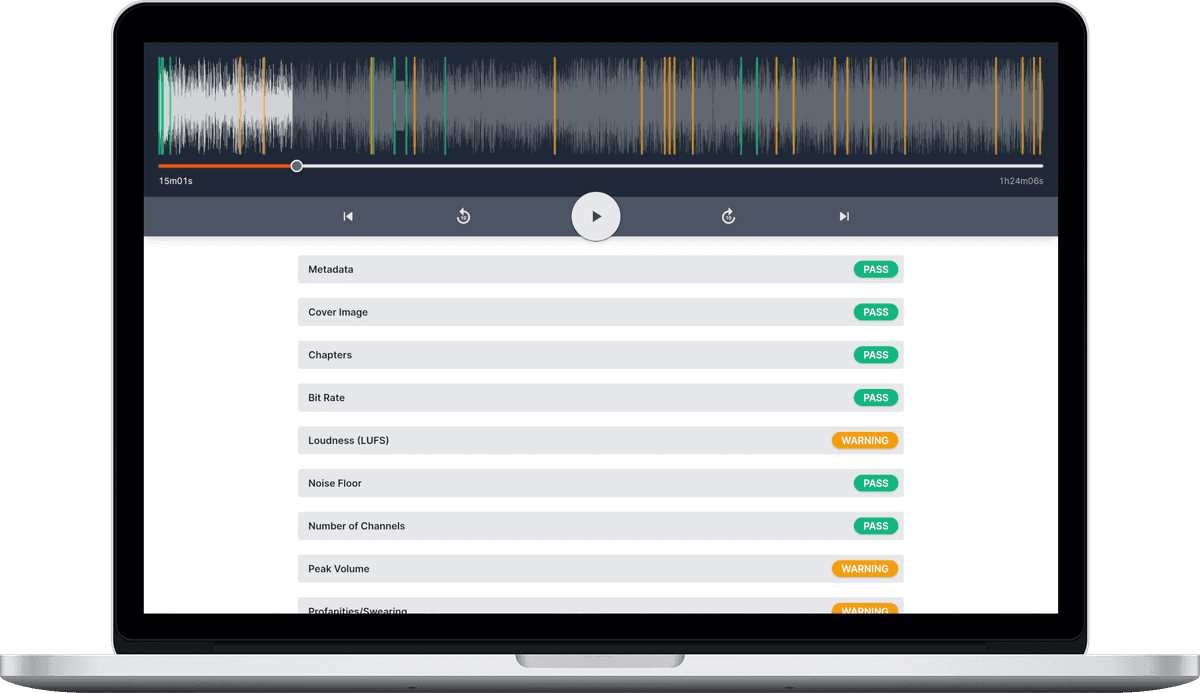
Audio Audit is a different kind of tool. It doesn’t record, edit or host; it reads the finished episode, measures whether it’s fit to publish, fixes the specific things that aren’t, and keeps checking your feed after you’ve moved on. As of August 2026 that includes the fixing: with Enhancements, it applies noise reduction, speech levelling, loudness normalisation and clean metadata, and then you re-run the report to prove the numbers actually moved. Analyse, fix, verify.
The short version: Async wants to be the one tab your whole podcast lives in; Audio Audit is the measuring pass you run over whatever comes out of it.
This page was last fact-checked against async.com in September 2026.
Comparison Overview
File and Metadata Checks
| Feature | Async | Audio Audit |
|---|---|---|
| Metadata checking | ❌ No, episode details are typed in at publish, not checked | ✅ Yes |
| Cover art checking | ❌ No | ✅ Yes |
| Chapter checking | ❌ No | ✅ Yes |
| Bit-rate checking | ❌ No | ✅ Yes |
| Sample-rate checking | ❌ No | ✅ Yes |
| Sample-width checking | ❌ No | ✅ Yes |
| Channel count checking (stereo/mono) | ❌ No | ✅ Yes |
Analysis and Detection
| Feature | Async | Audio Audit |
|---|---|---|
| LUFS/loudness checking | ❌ No, Magic Dust never states or reports a loudness figure | ✅ Yes |
| Peak volume checking | ❌ No | ✅ Yes |
| Noise floor checking | ❌ No | ✅ Yes |
| Unwanted noise detection (coughs, knocks, pets, etc.) | ❌ No, noise is removed rather than flagged | ✅ Yes, dozens of noise types |
| Filler word detection (uhm, ahh, etc.) | ✅ Yes, detected for you to review — on the Pro plan | ❌ No |
| Long silence detection | ✅ Yes, found and removed in a click | ✅ Yes |
| Restarted sentence detection | ❌ No | ✅ Yes |
| Swearing detection | ❌ No | ✅ Yes |
| Automatic transcriptions | ✅ Yes, five languages so far | ✅ Yes |
Enhancement and Editing
| Feature | Async | Audio Audit |
|---|---|---|
| Audio file modification | ✅ Yes | ✅ Yes (Enhancements) |
| One-pass enhancement of a finished episode | ✅ Yes (Magic Dust), one click | ✅ Yes — measured processing, no generative AI |
| Noise reduction | ✅ Yes, including echo | ✅ Yes, profile measured from your recording |
| Speech levelling (compression) | ✅ Yes, volume spikes evened out as part of Magic Dust | ✅ Yes |
| Loudness normalisation (LUFS targets) | ❌ No target to set, no figure reported | ✅ Yes, presets for podcasts, YouTube and ACX |
| Metadata & cover art writing | ❌ No | ✅ Yes, without re-encoding audio |
| Automatic filler word removal | ✅ Yes, after your review, on Pro | ❌ No |
| Automatic silence removal | ✅ Yes | ❌ No |
| Transcript-based editing | ✅ Yes (Text Mode) | ❌ No |
Monitoring and Reporting
| Feature | Async | Audio Audit |
|---|---|---|
| Automatic reports by email | ❌ No | ✅ Yes |
| RSS feed monitoring | ❌ No, though the free Hosting Hub serves your feed | ✅ Yes |
| Scoring over the long-term across shows and team members | ❌ No | ✅ Yes |
Plans and Pricing
| Feature | Async | Audio Audit |
|---|---|---|
| Free trial | ✅ Yes, the free plan is the trial | ✅ Yes |
| Free tier | ✅ Yes — unlimited audio recording, with lifetime caps on video and transcription | ✅ Yes, free credits every month |
| Pricing model | Subscription tiers (unchanged through the rebrand) | Pay-as-you-go credits or subscription — see /pricing |
| One-off credit top-ups (no subscription needed) | ❌ No | ✅ Yes — credit packs valid 12 months |
One Tab for the Whole Show
Async’s pitch is breadth, and the breadth is real. The Recording Studio takes you and up to ten remote guests, each captured on a separate local track so a bad connection degrades the call rather than the recording. Text Mode gives you the modern editing trick — delete the sentence in the transcript and the audio goes with it. Magic Dust is the one-click clean-up: background noise and echo removed, dynamic range optimised, volume spikes evened out, in the vendor’s words a “professionally mastered studio-quality recording”. Revoice will clone your own voice for fixes and ad reads — and credit to Async for the consent apparatus around it: you record seventy prompted sentences plus an explicit permission statement before a clone is built. And when the episode’s done, the free Hosting Hub gives you an RSS feed, a show page and one-click submission to the directories, which removes a bill most podcasters assume is mandatory.
Filler words deserve their own sentence, because Async handles them the honest way: they’re detected and presented for review — “you decide whether you want to ignore or delete” — rather than silently cut. That’s the same pattern we praised Alitu for, and it’s the right one.
Audio Audit does none of this, and we have no plans to bluff at it. No recorder, no editor, no clones, no hosting. We detect long silences, restarted sentences and stray noises, and mark them with timestamps so you know how much of a problem you have and where it is — but you cut them somewhere else. In Async, quite possibly. Filler words we don’t detect at all; on Pro, Async does.
Magic Dust: Polished — But to What Number?
The standard loudness for podcasts is -16 LUFS, and our customers tell us it’s the number one thing they check their reports for.
Here’s what you can’t learn from Async, at any plan level: what loudness your episode actually is. Magic Dust promises mastering-grade polish, and by most accounts delivers a pleasant-sounding file — but nowhere in the product or its documentation is a loudness target stated, a standard named, or a measured figure reported. There’s no -16 LUFS to aim at, no readout to confirm, and no way to know whether the “studio-quality” file matches the loudness of the shows either side of yours in a listener’s app. The polish is real; the number is a secret, apparently even from the tool itself.
Audio Audit’s processing is built the other way round. Every stage measures before it acts: noise reduction builds a profile from the quietest moments of your recording and subtracts it frequency by frequency, capped at 12 dB — below the point where spectral processing on speech starts to sound underwater; speech levelling sets its threshold from your measured speech level; volume normalisation ships with presets for podcast platforms (-16 LUFS), YouTube (-14 LUFS) and ACX audiobooks (-19 LUFS), with true-peak-safe limiting and a custom option, on the same ITU-R BS.1770 model broadcast uses — measure the whole episode, apply one constant gain change, never touch how it breathes. Nothing is generative, nobody’s voice is synthesised, and the same input gives the same output every time. Then the fresh report puts the integrated loudness next to the true peak, in writing.
After the Hosting Hub
Publishing through Async’s Hosting Hub is a genuine convenience: feed, show page, directory submission, done. But serving a feed and checking one are different jobs. Nothing in Async examines the finished file the way a directory will — no metadata or artwork check, no bit-rate or channel report, no noise floor, no swearing flag before the explicit tag becomes a problem. And once episodes are out, nothing watches them.
Audio Audit picks up both halves. The report reads the finished file and checks it against everything a podcast directory and a listener care about, with the failing checks’ fixes pre-ticked — and if metadata is the only thing you change, the audio isn’t re-encoded at all. Then point the feed monitor at your show — an Async-hosted feed included — and it re-checks the file your host actually serves, which isn’t always the file you uploaded: hosts re-encode, and a re-encode can shift your loudness and clip your peaks long after every tool in your chain has finished and gone home. Reports arrive by email, scores build across episodes, shows and team members, and the trend tells you whether your audio is quietly getting worse.
Paying For It
The rebrand changed the name and nothing on the bill — Async said so itself. As of September 2026 there’s a free plan with unlimited audio recording (the caps are on video, transcription and storage, some of them lifetime rather than monthly totals — one hour of transcription ever, on the free tier), then a Storyteller tier at roughly $12 a month billed annually, and Pro at roughly $24, which is where filler-word detection and Revoice live. Async’s pricing page renders its numbers dynamically, so check async.com/pricing for what you’d actually pay rather than trusting this paragraph.
Audio Audit runs on credits, with free credits every month, monthly plans if your usage is steady, and one-off top-up packs valid for 12 months if it isn’t. Reports and enhancements draw on the same balance — a full clean-up costs about the same per minute as a full standard analysis — and you see the estimate before you commit. Current prices live on the pricing page rather than in this article, because comparison pages go stale and pricing pages don’t. If you publish monthly, or you just want one troublesome episode checked and fixed, nobody is asking you for a subscription.
So Which One?
If you want your whole show in one browser tab — record the guests, cut the transcript, sprinkle the Magic Dust, publish to a free feed — use Async. The breadth is real, the filler-word review is done right, and the free tier is a generous way to find out if the workflow suits you.
If you want to know what the finished file actually is — the loudness figure Magic Dust never mentions, the true peak, the noise floor, the tags and artwork a directory will check even though your studio didn’t — with the fixes applied and verified, and a monitor on your feed from then on, that’s Audio Audit.
And they chain without friction: make the episode in Async, download it, and run it through Audio Audit before you publish — then point the feed monitor at your Hosting Hub RSS and let it check what your listeners are really being served, every episode, from now on.
Want the full detail on what Audio Audit’s enhancements do? See the Enhancements announcement and the Enhancing Audio guide, or head to the Pricing page to see what a report or an enhancement costs for your episode length. Comparing other tools too? We’ve written the same honest breakdown for Alitu, Auphonic, Descript, Adobe Podcast Enhance and Cleanvoice.
Photos courtesy of Andreas Weilguny