Podcast RSS Feed Validators vs. Audio Audit (comparison)
 Damian Moore, Last updated: 6 September 2026
When a podcast directory rejects your show, or episodes stop appearing in Apple Podcasts, the standard advice is: run your feed through a validator. It’s good advice. Feed validators — Castos’s, Blubrry’s Cast Feed Validator, Podbase, Beamly’s — read your RSS XML and check it against the rules the directories enforce: required tags, valid enclosures, stable GUIDs, artwork specs, HTTPS. They’re free, they’re fast, and when the problem is in the XML, they find it.
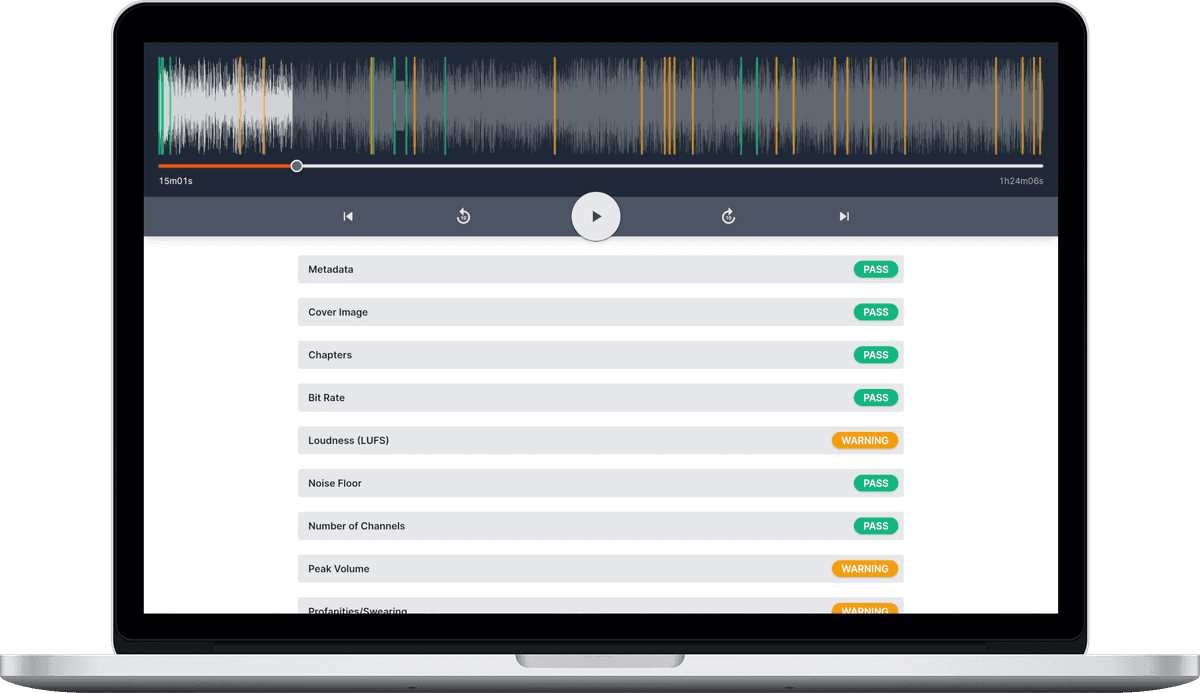
This page is about what happens after the XML passes. A validator reads your feed’s markup, once. Audio Audit’s feed monitoring reads what the markup points at — the actual audio files your host serves your listeners — and keeps reading them: every episode, measured for loudness, true peak, noise floor, bit rate, channels, metadata, artwork and content problems, with reports by email and scores over time. As of August 2026 it fixes what it finds too, with Enhancements for noise reduction, speech levelling, loudness normalisation and clean metadata. Analyse, fix, verify.
The short version: validators check that your feed is well-formed; Audio Audit checks that what your feed delivers is good — and keeps checking.
This page was last fact-checked against each validator’s own site in September 2026.
What a Feed Validator Actually Checks
The validators’ shared checklist maps closely to Apple’s published requirements, and it’s worth knowing because these really are the errors that keep shows out of directories: RSS 2.0 compliance and well-formed XML; the iTunes namespace tags (title, description, category, author, explicit); an enclosure tag on every episode with URL, length and type; a globally unique GUID per episode that never changes; show artwork between 1400 and 3000 pixels square, JPG or PNG, no transparency; HTTPS everywhere; and a hosting server that answers HEAD and byte-range requests, because that’s how podcast apps actually stream. Get any of these wrong and a validator will tell you in seconds, for free. Take that offer.
The Validators, One by One
Castos RSS Feed Validator
The most thorough of the hosting-company tools: XML validity, HTTPS delivery, required and recommended tags, duplicate GUIDs and audio URLs, byte-range support on feed, image and audio URLs, cover image specs, Podcasting 2.0 tags, even redirect health. It’s a free lead magnet for Castos’s hosting, and a well-built one. It confirms your audio files are reachable — it never listens to them — and it stores nothing: one check, one report, no history.
Cast Feed Validator (Blubrry)
The long-serving incumbent, owned by Blubrry since 2017. Its own about-page claims over a hundred checks across four phases: XML against RSS 2.0 and Apple’s spec, feed-server configuration and speed, artwork compliance, and an analysis of the most recent episode’s file metadata and server setup — the closest any validator gets to the audio, though it’s checking delivery and headers, not sound. Free, still maintained, one-off.
Podbase
The minimalist independent (podba.se): paste a URL, get a clean pass/fail against Apple compatibility and podcast-standards basics. It’s a one-person tool with no visible development activity in years — it still works, but treat it as a quick second opinion rather than an authority.
Beamly Podcast Feed Validator
Beamly is the platform formerly known as Podcastpage.io, and its free validator covers the modern checklist: RSS structure, enclosure URLs and MIME types, GUIDs and dates, the iTunes namespace, HTTPS, and a useful spread of Podcasting 2.0 tags (locked, funding, value). Like the others: free, XML-only, once.
Beyond these four sit Livewire’s Podcasting 2.0-aware validator, the venerable W3C feed validator (generic RSS, no podcast awareness — the wrong tool, as the podcast-specific vendors rightly point out), and a 2026 wave of templated SEO-site checkers offering the same XML checks with less provenance. The pattern across every one of them is identical: markup, once, free.
Comparison Overview
| Feature | Feed validators | Audio Audit |
|---|---|---|
| RSS/XML validity checking | ✅ Yes, that’s the product | ❌ Not our job — we parse your feed to fetch episodes, not to lint it |
| Apple/iTunes tag checking | ✅ Yes | ❌ No |
| Feed artwork spec checking | ✅ Yes, dimensions and format | ✅ Yes, on the episode files themselves |
| Enclosure reachability | ✅ Yes, headers and byte-range support | ✅ Yes — we download the file itself |
| Downloading and measuring the served audio | ❌ No, none of them listen | ✅ Yes, every episode |
| LUFS, true peak and noise floor of served episodes | ❌ No | ✅ Yes |
| Bit rate, sample rate, sample width, channels of served episodes | ❌ No | ✅ Yes |
| Metadata and cover art inside the audio files | ❌ No | ✅ Yes |
| Swearing, filler words, silences, restarted sentences, stray noises | ❌ No | ✅ Yes, with timestamps |
| Continuous monitoring (not just one check) | ❌ No, every validator is one-off | ✅ Yes |
| Automatic reports by email | ❌ No | ✅ Yes |
| Scoring over the long-term across shows and team members | ❌ No | ✅ Yes |
| Fixing what’s found | ❌ No | ✅ Yes (Enhancements), then re-verify |
| Price | ✅ Free | ✅ Free credits every month; then credits — see /pricing |
A Valid Feed Can Serve a Broken Show
Here’s the gap the whole validator category leaves open, stated plainly: a feed can pass every check on every validator above while serving episodes that are unlistenable. The XML doesn’t know that episode 41 came out at -28 LUFS because someone bounced it without normalising. It doesn’t know the new editor’s exports are clipping, that the intro music got mono-collapsed, that the last three episodes carry the old cover art inside the MP3, or that there’s an unbleeped word four minutes into your clean-rated show. Every one of those ships through a green-ticked feed, because the feed is just the envelope.
And the envelope’s contents change without you. Your host re-encodes — some as standing policy — and a re-encode can shift loudness and clip peaks on a file you checked carefully before upload. A validator run on launch day says nothing about what your feed serves in March. That’s why Audio Audit’s monitor is continuous: it pulls the enclosure your feed actually points at, runs the full report on the audio inside it, emails you when something’s off, and builds scores across episodes, shows and team members so a slow drift shows up as a trend rather than a listener complaint.
Use Both, in the Right Order
This is the second roundup on this site (after the free LUFS meters) where the honest advice is both. When you launch a show, move hosts, or chase a directory rejection, run a validator — Castos’s or Blubrry’s first — because XML problems are their home ground and the price is zero. The validators are lead magnets for good companies; take the free work.
Then cover the half they leave open. Point Audio Audit at the feed and let it audit the audio behind the XML, continuously. The free monthly credits mean a small show can run this for nothing; beyond that it’s credits — one-off top-up packs valid 12 months, or monthly plans if your usage is steady, with the estimate shown before you commit and current prices on the pricing page, because comparison pages go stale and pricing pages don’t.
Your feed’s markup, checked once, by them. Your feed’s audio, checked forever, by us. That’s the whole division of labour — and your listeners only ever hear one of the two.
Want the full detail on what Audio Audit’s enhancements do? See the Enhancements announcement and the Enhancing Audio guide, or head to the Pricing page to see what a report or an enhancement costs for your episode length. Comparing other tools too? We’ve written the same honest breakdown for the free LUFS meters, as well as Auphonic, Alitu, Descript and Buzzsprout Magic Mastering.
Photos courtesy of Vlad Hilitanu