Free LUFS Meters vs. Audio Audit (comparison)
 Damian Moore, Last updated: 15 October 2026
Sooner or later every podcaster asks the same question: what’s my episode’s LUFS? It’s the right question — loudness is the number one thing our customers check their reports for — and the internet has grown a whole shelf of free tools that answer it: a famous plugin, a couple of long-running browser meters, and a fresh wave of one-page checkers. This page is about that shelf: what each free meter genuinely does, where the catches are, and what a number on its own can’t tell you.
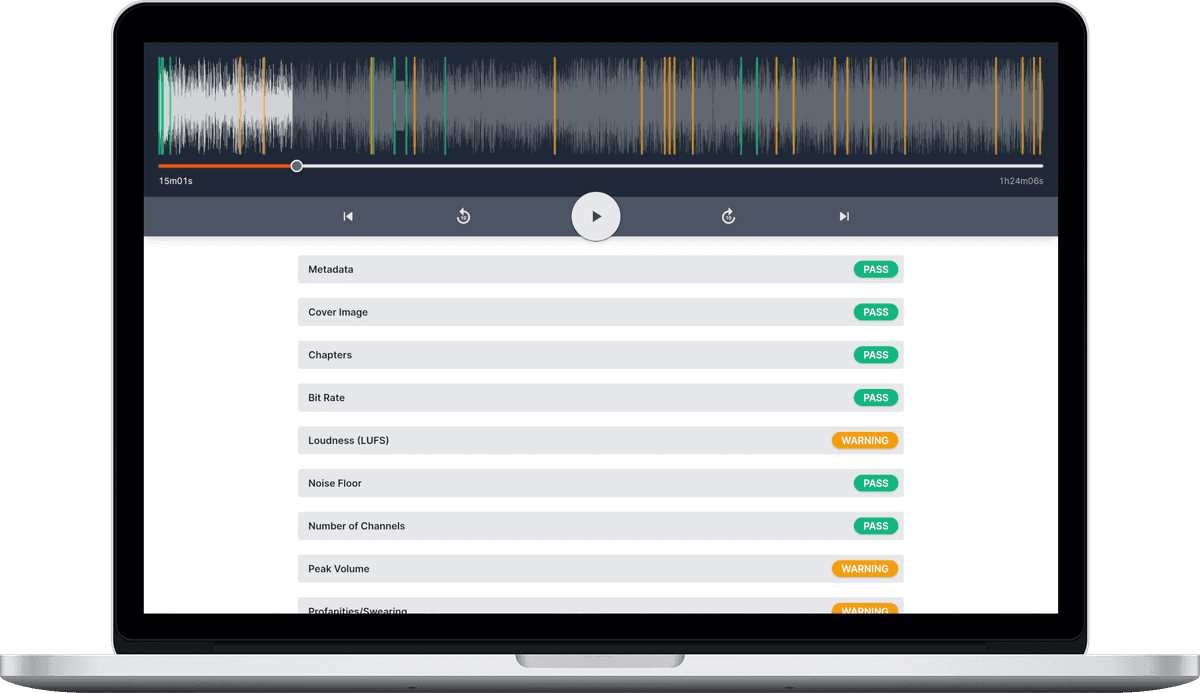
Because that’s the honest framing. A LUFS meter answers one question about one file at one moment. Audio Audit asks all of them: the same integrated loudness and true peak, plus the noise floor, bit rate, sample rate, sample width, channel count, metadata, cover art, chapters, swearing, long silences and restarted sentences — and then it keeps asking, by watching your RSS feed and re-checking what your host actually serves. As of August 2026 it fixes what it finds, too, with Enhancements for noise reduction, speech levelling, loudness normalisation and clean metadata. Analyse, fix, verify.
The short version: the free meters measure a number; Audio Audit audits the file behind it — and the feed behind that.
This page was last fact-checked against each tool’s own site in September 2026.
The Number Everyone Is Chasing
The podcast convention is -16 LUFS integrated loudness. That’s not folklore: Apple’s official audio requirements say episodes should sit “around -16 dB LKFS, with a +/-1 dB tolerance” with true peak no higher than -1 dB, measured to ITU-R BS.1770 (LKFS and LUFS are the same unit wearing different badges). Spotify normalises music playback to -14 LUFS and YouTube’s playback normalisation is commonly measured at the same figure, which is why our normalisation presets offer -16 for podcast platforms, -14 for YouTube and -19 for ACX audiobooks. If your episode is far from those numbers, playback normalisation — or your listener’s thumb on the volume — will do something about it, and not always kindly.
So measuring is the right instinct. Here’s the shelf.
The Free Meters, One by One
Youlean Loudness Meter 2 (free version)
The famous one, and deservedly: a polished plugin (VST/AU/AAX) that meters integrated loudness, loudness range, true peak and dynamics in real time inside your DAW, free, with a $29 one-time Pro unlock. Two catches for podcasters. It’s a plugin — you need a DAW to host it, and the free version meters audio as it plays rather than analysing a file you drop on it; drag-and-drop file analysis is a Pro feature, as are the streaming-platform preset targets and exportable reports. If you already live in Reaper or Logic, it’s excellent. If you just have an MP3 and a question, it’s more machinery than the question needs.
lufs.org
The minimalist one: drag a file onto the page and get integrated loudness, sample peak, true peak, loudness range and more, processed locally in your browser — your audio never leaves your machine, which is the right way to build these. Two catches: it accepts WAV and FLAC only, and most finished podcast episodes are MP3s, so you may be measuring your pre-export master rather than the file your listeners get; and the site is aimed at broadcast and music generally, with no podcast targets, no pass/fail, and no name on the door.
Podtools
A free browser toolbox with a loudness analyzer that takes MP3 and WAV, runs locally in the browser, and can even normalise to platform targets and hand the file back. The wider site is a drawer of separate free podcast utilities — an RSS validator, an ID3 tag editor, a cover art size checker — which makes it the closest thing on this shelf to an audit, with one structural difference: each tool is its own page, its own upload and its own answer. You are the integration layer, and nothing keeps a record.
Sound & Go
A tidy browser meter from a small podcast-editing outfit: integrated and short-term LUFS, true peak, loudness range, everything processed in the browser with no upload, most formats accepted, no file-size limit, and normalisation to named platform presets with a downloadable result. The candid limits are its own: one file at a time, big files take minutes, and there’s no report to keep. It’s a lead magnet for their editing services — a perfectly honest one.
ffmpeg (the one that powers the others)
The command-line answer, free and absolute: ffmpeg’s ebur128 filter measures integrated loudness, range and true peak to the letter of the standard, and loudnorm will normalise to any target in one or two passes. Its own documentation even notes that “material published online may prefer a level of -16LUFS (e.g. for use with podcasts or video platforms)”. The catches are the terminal itself, and a default that bites: loudnorm targets -24 LUFS unless you say otherwise, so the copy-pasted command that “just works” quietly delivers a broadcast-TV level. Type I=-16:TP=-1 every time, or script it — which is roughly the moment you’ve started building a small, unpaid audit tool of your own.
And beyond these, the 2026 search results teem with one-page checkers — TryPeak, WizCut and friends — most of them genuinely free, in-browser and privacy-clean, some with helpful per-platform pass/fail readouts. The pattern holds across all of them: a number, now, for one file.
Comparison Overview
| Feature | Free LUFS meters | Audio Audit |
|---|---|---|
| Integrated LUFS measurement | ✅ Yes, that’s the product | ✅ Yes |
| True peak measurement | ✅ Mostly — a few free tiers hold it back | ✅ Yes |
| Noise floor checking | ❌ No | ✅ Yes |
| Metadata checking | ❌ No (Podtools has a separate tag tool) | ✅ Yes |
| Cover art checking | ❌ No (Podtools has a separate size checker) | ✅ Yes |
| Bit-rate / sample-rate / sample-width / channel checks | ❌ No | ✅ Yes |
| Swearing, silences, restarted sentences | ❌ No | ✅ Yes, with timestamps |
| Unwanted noise detection (coughs, knocks, pets, etc.) | ❌ No | ✅ Yes, dozens of noise types |
| Fixing what’s found (normalisation, noise reduction, metadata) | ❌ Mostly not — a couple normalise to a preset | ✅ Yes (Enhancements), then re-verify |
| A report you can keep and share | ❌ No, the number vanishes with the tab | ✅ Yes |
| RSS feed monitoring | ❌ No | ✅ Yes |
| Automatic reports by email | ❌ No | ✅ Yes |
| Scoring over the long-term across shows and team members | ❌ No | ✅ Yes |
| Price | ✅ Free (Pro unlocks $29+ one-time where they exist) | ✅ Free credits every month; then credits — see /pricing |
A Number Is Not an Audit
Suppose the meter says -16.2 LUFS. Good news — and now consider what you still don’t know. Whether the true peak clears Apple’s -1 dB ceiling. Whether the noise floor under your voice is creeping up month on month. Whether the file is accidentally 32 kbps mono because of an export preset you fat-fingered, whether the cover art embedded in it is the old logo, whether the metadata says “Untitled Project 7”, whether there’s a swear word four minutes into your family-friendly show, and whether the ninety-second silence where the call dropped made it into the final cut. Every one of those has sunk more episodes than loudness ever has, and no LUFS meter looks at any of them.
Then there’s the question none of these tools can even ask: what is your feed serving? The file you measured is the file on your desktop. Your host re-encodes — some as policy — and a re-encode can shift loudness and clip peaks after every meter has closed its tab. Audio Audit’s monitor pulls the enclosure your RSS feed actually points at, runs the full report on it, emails you the result, and scores episodes over time so a slow drift shows up as a trend rather than a surprise. One number, once, is a spot check. This is the audit.
Free Is the Right Price for a Number
Let’s not pretend otherwise: if all you need is an occasional loudness reading, the free shelf has you covered, and several of these tools are built with real care — local processing, no uploads, no accounts. Use them; they’re good.
Audio Audit’s free tier is the same spirit applied to the whole audit: free credits every month, enough to run reports on an occasional show without paying anything. When you need more — bigger back catalogue, weekly episodes, the fixes as well as the findings — it’s credits: one-off top-up packs valid 12 months, or monthly plans if your usage is steady, with reports and enhancements drawing on the same balance and the estimate shown before you commit. Current prices live on the pricing page rather than in this article, because comparison pages go stale and pricing pages don’t.
So Which One?
Keep a meter in your production chain — Youlean in the DAW if you edit, a browser checker for a quick mid-mix sanity read. Mid-production, a fast free number is exactly the right tool.
For the finished artefact, run the audit: every number the meters give you, plus the 20+ checks they don’t, the fixes pre-ticked where checks fail, and verification that the numbers actually moved. Then point the feed monitor at your show, and let the question “what’s my podcast’s LUFS?” answer itself — every episode, on the file your listeners actually get, forever.
Want the full detail on what Audio Audit’s enhancements do? See the Enhancements announcement and the Enhancing Audio guide, or our explainer on Loudness (LUFS). Comparing full products instead of meters? We’ve written the same honest breakdown for Auphonic, Alitu, Descript, Adobe Podcast Enhance and Cleanvoice.
Photos courtesy of Johannes Mändle