How to Build Suspense and Tension in a Podcast
 Damian Moore, Last updated: 4 November 2026
Our guide to podcast storytelling gives suspense and tension a couple of paragraphs. This article goes further, with techniques you can use in the script, in the edit and in the final file. Most of them come from narrative and true crime shows, but they work just as well for interviews and documentaries. Any episode that leaves the listener wanting to know what happens next is using suspense.
Suspense comes from what the listener knows
Alfred Hitchcock explained the difference between surprise and suspense to François Truffaut with a bomb under a table. Two people sit talking, and the bomb goes off without warning: the audience gets a few seconds of shock. Now play the same scene but show the audience the bomb first, and a clock on the wall. The conversation is just as dull, but every second of it is tense, because the audience knows something the characters don’t.
The lesson for podcasters is that holding everything back until the reveal gives you surprise, which lasts a moment. Suspense comes from telling listeners enough to worry about. Let them know early that something is going to go wrong, that a guest is about to change their mind, or that the person on tape is not who they say they are. Then make them wait.
Give the episode a question
Ira Glass has described a story as a sequence of events that keeps raising questions and answering them. The listener stays because there is always something they don’t know yet.
For a series, the writers interviewed by Nieman Storyboard in The making of binge-worthy serial narratives talk about an “engine”: a central question that can’t be settled in one sitting. For Serial’s first season it was whether Adnan Syed really did it. Christopher Goffard, who wrote the Framed series, describes how the question shifts once it is answered: “The question is, ‘Who set her up?’ When that gets answered, the question is, ‘Why?’”
Before you script or edit an episode, write down the question it asks. If you can’t name one, the episode probably has information but no tension. When you answer a question, it helps to have the next one ready.
Open in the middle
A cold open is a short clip that plays at the very start of an episode, before the theme music, the show’s name or any welcome from the host. The term comes from TV, where many dramas and sitcoms run a scene before the opening titles. In a podcast it is usually under a minute: a striking line from an interview, a moment from later in the story, or a scene that starts mid-action. The listener hears it without being told who is speaking or what is going on, and that missing context is the point.
Say your episode is about a restaurant that closed overnight. A conventional opening would welcome listeners, introduce the topic and give some background. A cold open might play ten seconds of the owner saying, “I locked the door at eleven, and by morning the keys didn’t work any more,” then go straight into the theme music. The listener now wants to know what happened, and they’ll sit through the intro to find out.
StudioBinder’s guide to cold opens in TV puts the main purpose plainly: to “grab the audience’s attention as soon as possible”. In a podcast it does that by giving the listener a question before they’ve heard anything else. It also means the first thing a new listener hears is the story rather than the branding. Our article on podcast intros and outros suggests keeping the intro to 15–30 seconds, and that matters more after a cold open, because a long intro lets the tension drain away before the story starts again.
Raise the stakes and add a clock
Tension needs something to lose. It could be someone’s freedom, their money or a relationship. In an interview it might just be the guest’s reputation, or a decision they still regret. Say out loud what is at risk, early, so the listener knows what they are worrying about.
A deadline sharpens it. Hitchcock’s clock on the wall made the bomb scene work, and podcasts can use the same trick: a court date, a countdown, a phone call that has to happen before morning. Even “by the end of this episode you’ll know why she never went back” gives the listener a clock.
Pace the reveals
Suspense is a matter of how fast you hand over information. Give out clues in steps, each one changing what the listener believes, and keep the big answer back until it has been earned.
Tangents stop the clock. In the same Nieman Storyboard piece, Roy Peter Clark warns about anything that invites people “to stop moving forward”. In a podcast that is usually a long aside, a sponsor read in the wrong place or a recap of something the listener already knows. Our tips for engaging episodes already say to keep it focused, and that goes double in the run-up to a reveal. Save the tangents for afterwards, and put ad breaks at a moment of high tension rather than straight after a payoff, so the listener has a reason to wait through them.
Short, plain sentences in the tense parts help too. Listeners can’t re-read a sentence, and a long one with three clauses loses them just when you need them following closely.
Use pauses, but keep them short
A well-placed pause before a reveal makes the listener lean in. Radio presenters are trained to fear dead air, but the talent coach Randy Lane argues in Radio Ink that a deliberate pause is a valuable technique, and building suspense before a key point is one of the uses he lists. As he puts it, “Dramatic pauses touch listeners emotionally and they remember them.”
There is a limit, though. As our Silences in the Middle article explains, after a few seconds of nothing most listeners stop hearing a dramatic pause and start wondering whether playback has stalled. They pick up their phone, and from there it’s one tap to skip. A beat of a second or two is usually enough.
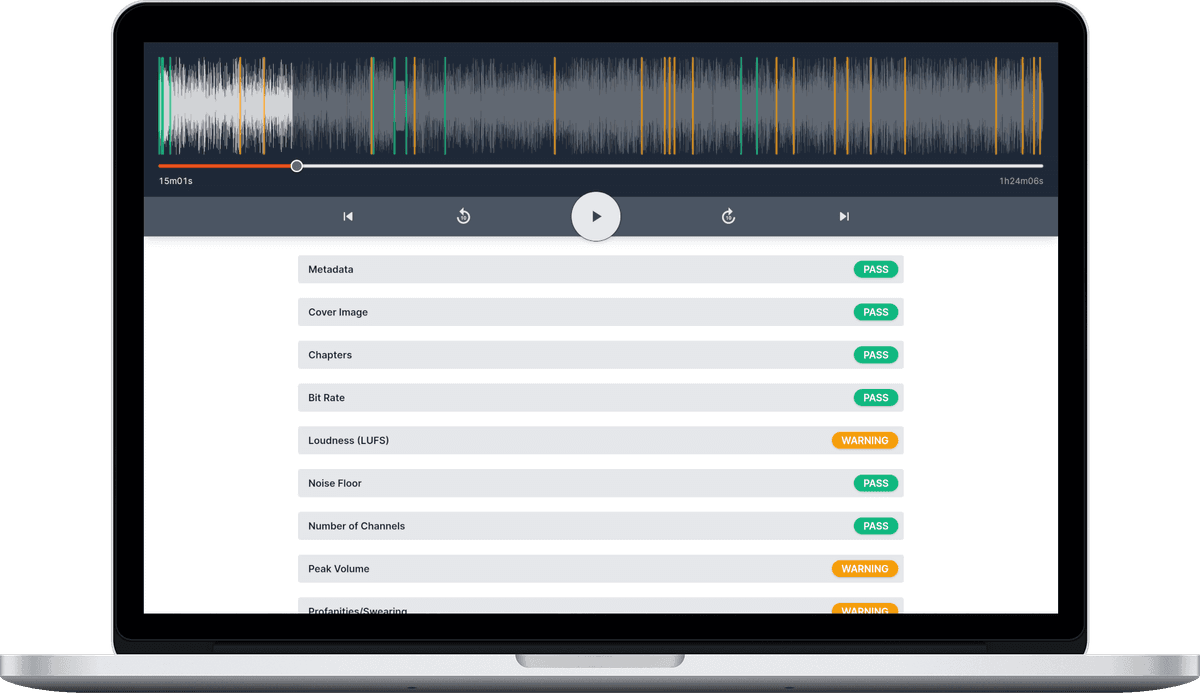
When you do want a longer pause, fill it with a little room tone instead of digital silence, so it still sounds like a room with people in it. Audio Audit’s Silences in the Middle check flags gaps of 3 seconds or more by default. If your show uses long pauses on purpose, a custom standard lets you raise that limit so the deliberate ones aren’t flagged, while accidental gaps from a bad edit still are.
Pauses also show your background noise. In a quiet moment there is no voice to cover hiss or hum, so a tense silence can end up sounding like a fan. Our guide to lowering your noise floor covers how to get it down before you record.
Let sound do some of the work
Music and sound effects can build dread, and the storytelling article covers soundscapes in more detail. Two things matter most for tension. Less is usually more, and pulling the music out at the key moment often lands harder than adding a sting. The other is to keep each sound effect doing a job: a door, footsteps, a phone buzzing in the next room. Off-mic sounds suggest something is happening that the listener can’t see.
A whispered confession or a hushed line of tape can be the tensest part of the episode, but only if people can hear it. Our article on the psychology of listening cites a RAJAR survey in which 81% of podcast listeners were doing something else at the same time, often driving or doing chores. A moment mixed far below the rest of the episode gets lost under road noise. Keep quiet moments quiet by comparison, but bring the whole episode to a sensible loudness (about -16 LUFS for stereo) so nobody has to reach for the volume.
End on a question
The classic cliffhanger stops mid-action. Caroline Waterlow, a producer on O.J.: Made in America, told Nieman Storyboard that the series avoided traditional cliffhangers and relied on open questions instead. That works well for non-fiction, where you can’t always invent a dramatic moment to stop on. End with the next question clearly asked, and the listener carries it with them until the next episode comes out.
At the start of the following episode a short recap helps people find their way back in. Transom’s Sound School episode The Episode Handshake calls the “previously on” recap effective but overused, so keep it brief and lead with the open question rather than a summary of everything so far.
Pay it off
Suspense is a promise. If the answer never comes, or turns out to be less than the build-up suggested, listeners feel cheated. Before Serial’s first season ended, NPR’s Monkey See was already writing about listeners wanting an ending that a true story might not be able to give. If you’re making non-fiction and you don’t know how it ends, be honest about that early, and make the question about something you can answer.
Don’t give it away in the metadata
It’s easy to build tension carefully in the edit and then spoil it in the episode title, the show notes or the chapter list. A chapter called “The confession” tells everyone what is coming, and listeners who skim chapters will skip straight to it.
Write chapter titles that point at the question rather than the answer. If you use Audio Audit’s automatic chapters, they are drafted from the transcript, so read the proposed titles before you apply them and rename any that give away a reveal. The same goes for episode titles and descriptions: tease the question, not the answer.
It works for interviews too
You don’t need a murder to build tension. In an interview show, tell the listener early that the guest has a story about the worst day of their career, then hold it until later in the episode. Edit out the tangents in the run-up. Our interview tips cover getting those stories out of guests in the first place. Then the same techniques apply: a question, some stakes, a pause before the answer and a payoff that lives up to the build-up.
Before you publish, listen back to the episode all the way through as a listener would, and note where your own attention drifts. Those are the places to cut.
Photos courtesy of Brunxs