Why Do People Listen to Podcasts? The Psychology Behind It
 Damian Moore, Last updated: 11 November 2026
People listen to podcasts to feel connected to a host who sounds like a friend, to learn about something they care about, and to make a dull job better company. The last reason matters more than you might expect. In the RAJAR MIDAS Summer 2022 survey, only 15% of podcast listening time was spent relaxing or doing nothing in particular. The rest happened alongside something else.
Why do people listen to podcasts?
Connection. A podcast puts a voice straight into your ears, usually while you are alone: the same RAJAR survey found that 93% of podcast listening is done alone. A host who talks to you in an ordinary voice, about things they care about, starts to feel like someone you know. Researchers call that a parasocial relationship. In a 2022 survey of 306 adults, the podcast listeners among them who had stronger parasocial bonds with their favourite host also reported a greater sense of relatedness, meaning the feeling of being connected to other people (Tobin and Guadagno, PLOS One). It was a one-off survey, so it shows the two go together and not that one causes the other. Even so, it is the clearest explanation I know for why a good show feels more like company than like media.
Learning. Podcasts let you hear people talk about a subject at length, which is hard to find elsewhere. If your interest is narrow, someone has probably made a show about it, and you can listen to experts work it through. The same study found that curiosity and a liking for thinking things through predicted who listened at all, so the authors concluded that wanting information can play a part in why people listen.
Finding your people. A smaller show can feel like a hidden gem. A community tends to form around it, and that sense of belonging keeps people coming back long after the topic stops being new.
Making time useful. Audio works when your eyes and hands are busy. People listen to podcasts while they are doing other things, and the RAJAR figures show what: working or studying made up 33% of podcast listening time, driving or travelling 22%, and sport, exercise or hobbies and household chores 10% each. A podcast turns dead time into time you feel you have used well.
Choice. You pick the show, the episode and the moment. Nobody schedules it for you, so it is easy to build a listening habit around your own interests.
Why do podcasts matter?
Podcasts matter because they fit around the day in a way few other media do. You can’t read a book while you drive, and you can’t watch a video while you wash up. A voice in your earbuds asks very little of you, and it still holds your attention for the length of an episode. If you have ever wondered how it feels to listen to a podcast, that is much of the answer: someone talking to you, close and unhurried, with no screen between you.
They also matter because of who gets to make them. Anyone with a microphone and an idea can publish, so shows exist for audiences no broadcaster would have commissioned. An independent host with a few hundred listeners can mean as much to those listeners as a big studio production does. And an episode can run to an hour or more, which gives a conversation room to go somewhere that short clips never do.
Sound quality is part of why it works. In two experiments published in 2018, people heard identical talks and radio interviews recorded at high or low audio quality. When the audio was poor, they judged both the research and the researcher less favourably (Newman and Schwarz, Science Communication). How something sounds colours what listeners think of the speaker and of what they say.
Is listening to podcasts good for you?
Mostly, yes, with caveats. The evidence is thinner than headlines suggest, so here is what I can stand behind.
The benefits. In the PLOS One study, people who listened to a wider range of different podcasts reported a stronger sense that their life has meaning, and so did people who were more socially engaged with podcasts. Hours spent listening made no difference, so the finding gives no reason to listen more. It also shows correlation only, and the authors say so. Beyond it, the plain benefits are the ones above. You learn things, and a friendly voice makes a long drive or a pile of ironing less lonely.
The downsides. Podcasts are easy to overdo. I think these risks are real, even though I can’t point you to a study for them:
- A big back catalogue can make listening feel like homework. If you feel guilty about the episodes you haven’t heard, you have stopped enjoying them.
- Listening all day leaves no room for your own thoughts. Leave some stretches of silence, or put music on instead.
- Shows about crime or conspiracy theories can pull you down a rabbit hole. If one leaves you uneasy, stop listening to it.
None of that is an argument against podcasts. It is an argument for choosing what you listen to, the way you would choose your friends.
What this means if you make a podcast
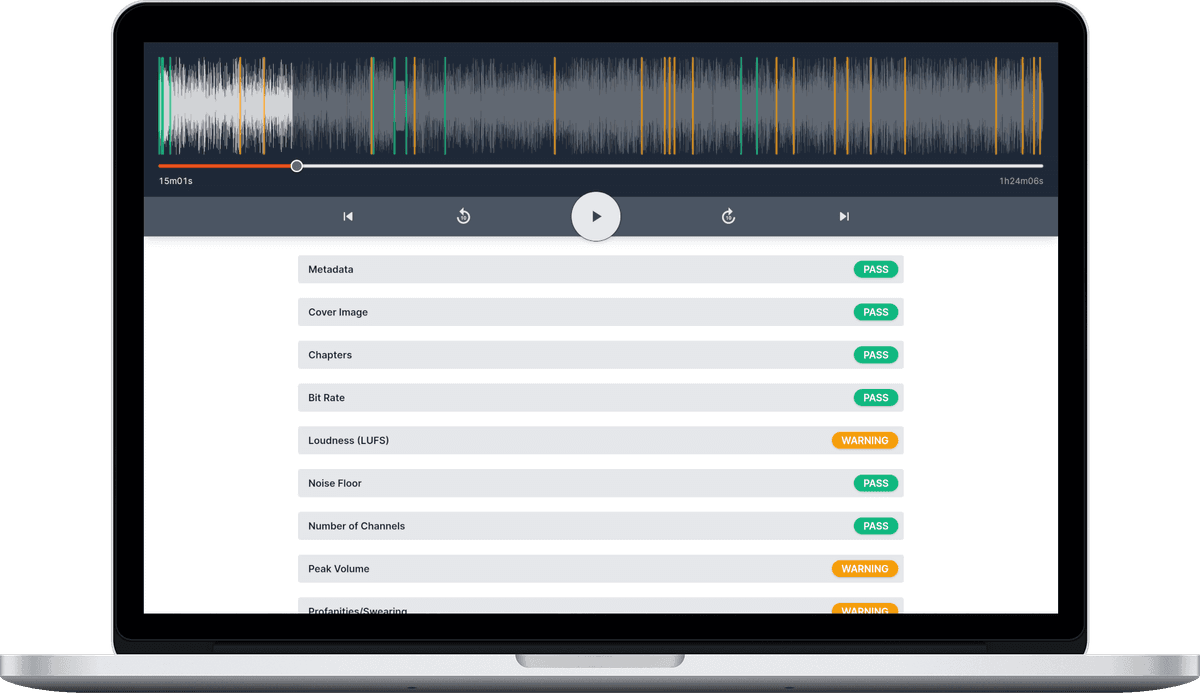
Listeners choose shows that feel like good company, and as the Newman and Schwarz experiments show, poor sound changes how people judge a speaker. If you publish a show, it is worth checking how it sounds before your audience does: too loud or too quiet, clipped, or noisy. Our podcast checker runs those checks on an episode automatically and tells you what to fix.

Photo credits: Oleksii Ihnatiev and Warren Wong