Unwanted Noises
 Damian Moore, Last updated: 15 October 2026
Our AI classifier is trained on all sorts of noises that may be undesirable in your recording. Example noises are Sneezes, Coughs, Bangs and Animals
A cough right in the middle of a sentence, the dog deciding the postman is a threat, a phone buzzing on the desk: these are the sounds that slip through an edit and make an otherwise polished episode feel rough. Listeners notice them, especially on headphones, and they can be jarring enough to pull someone out of the conversation.
What the check looks for
The Unwanted noises check listens for short, one-off sounds that you probably didn’t mean to publish. Broadly, it looks for:
- People noises — coughs, sneezes, throat clearing, sniffs, hiccups, chewing and the like
- Pets and other animals — dogs barking, cats, birds, insects
- Phones and alerts — ringing, notification beeps, alarms, buzzers, doorbells and bells
- Knocks and bangs — bumping the desk or microphone, things being dropped, clicks and taps
- Around the house — kitchen noises, cutlery and cups, running water, typing, keys jangling
- Outside — traffic, horns, sirens, aircraft and machinery
Detection runs on an AI audio classifier trained on a large library of labelled everyday sounds. We filter its labels down to the ones that are unwanted in a podcast, so intended sounds such as speech, music and laughter are left alone. You can read how we built it in our unwanted noise detection announcement.
How it differs from the noise floor
The noise floor check measures the constant background that sits under the whole recording — hiss, hum, the fan or the air conditioning. Unwanted noises are the opposite: transient sounds that happen once, at a particular moment. A recording can have a beautifully low noise floor and still have a sneeze in it, so the two checks work side by side.
How it shows on your report
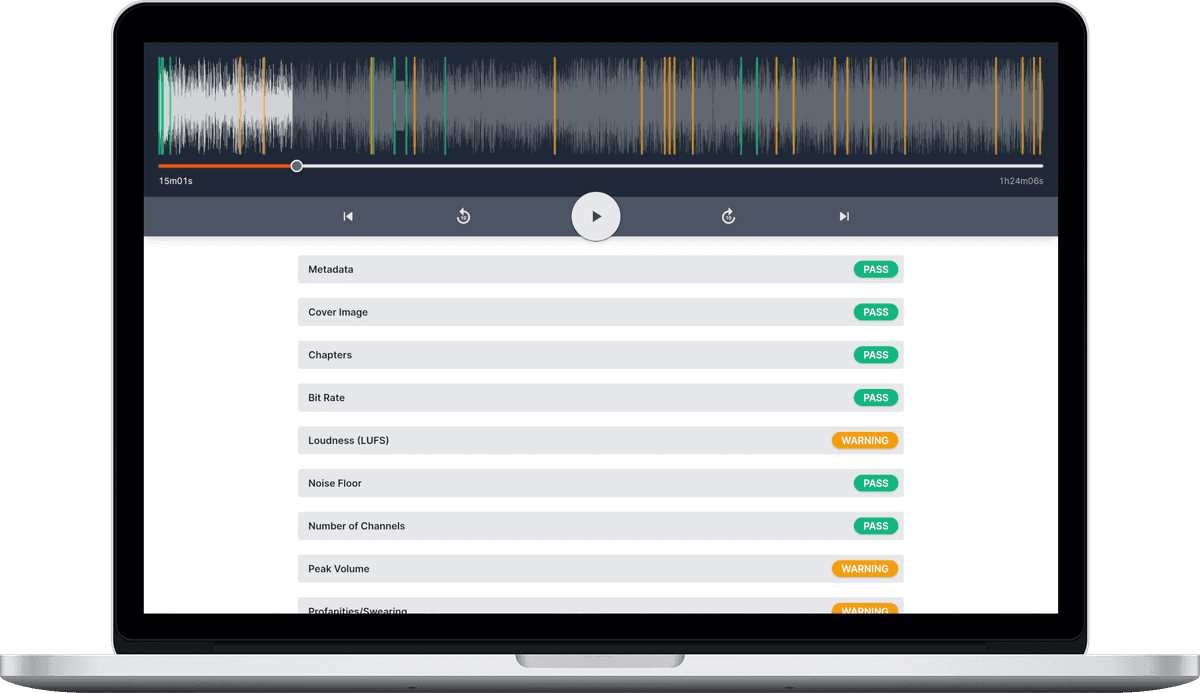
Each noise found appears as an amber marker on the report’s waveform. Open the check and you’ll see a list of findings, each with a description of the sound, how confident the classifier was, and a timestamp. Click one to play that moment. Each finding covers a five-second stretch of audio, so you’ll know roughly where to listen rather than the exact millisecond.
If the report has a transcript, each noise is also tagged on the phrase it overlaps, so you can see what was being said at the time. See podcast transcripts with speaker names for more on the transcript.
Listen before you cut
Noise detection is probabilistic: the classifier gives its best guess along with a confidence score, and it can be wrong. A laugh might be heard as a cough, or a hard consonant as a tap. Some flagged sounds may also be intentional — a sound effect, or a pet that’s part of the show. So treat each finding as a pointer to something worth a listen, not an instruction to delete it.
How to fix it
Most unwanted noises are quickest to fix in your editor:
- Cut it if the noise falls between words or sentences. Removing a cough from a pause is usually invisible.
- Duck it if it overlaps speech. Lowering the level just for the duration of the sound (with a short fade either side) often makes it unnoticeable without losing what was said.
- Gate the gaps on each speaker’s track. A noise gate or expander lowers the level whenever that person isn’t speaking, which tames breaths, keyboard clicks and shuffling from the people who aren’t talking.
Better still, stop them getting recorded in the first place:
- Mute discipline — guests and co-hosts mute when they’re not speaking, especially on remote calls, and phones go on silent and away from the desk.
- A close microphone — speaking close to a directional mic means your voice is much louder than the room, so distant sounds such as a dog in the next room or traffic outside are captured more quietly.
A note on enhancement: Audio Audit’s noise reduction is designed for constant background noise like hiss and hum. It won’t remove a cough or a bark, so for one-off sounds the editing steps above are the way to go.
Changing the check in a custom standard
In every built-in standard, Unwanted noises is Informational with a limit of at most 0: any noise found shows up as a note on the report, but it won’t fail it. In a custom standard you can make it Required if your show has a zero-tolerance policy, or turn it Off. Turning it Off also skips noise detection altogether, along with its cost, which can make sense for shows recorded somewhere you know is controlled.